Bayeux Day Trip: The Complete 2026 Visitor Guide

A Bayeux day trip is one of the most rewarding you can make from Caen — a genuinely beautiful medieval town, largely undamaged by the fighting that flattened Caen itself, and the historic home of the Bayeux Tapestry. Bayeux is around 30km from Caen and roughly 45km from the Portsmouth to Caen ferry terminal at Ouistreham, easily combined with Gold Beach or Omaha Beach on the same day, or visited as a relaxed half-day in its own right.

Important for 2026 visitors: the Bayeux Tapestry Museum closed on 1 September 2025 for a major renovation and will not reopen until October 2027. The Tapestry itself has left Normandy for the first time in over 900 years, on loan to the British Museum in London from 10 September 2026 to 11 July 2027. This is a genuinely unusual moment in the Tapestry’s history, and it changes what a Bayeux day trip in 2026 actually looks like — this guide explains exactly what you can and can’t see, and where.

This complete guide to a Bayeux day trip covers everything: what the Bayeux Tapestry actually is and why it matters, where to see it (and where you currently can’t), the town’s other essential sights — the cathedral, the Battle of Normandy Museum, the largest British war cemetery in France — plus the Viking-era history of Rollo of Normandy and Poppa of Bayeux that gave this town its place at the start of the Norman story, three centuries before the Tapestry was even made.

Last updated: July 2026 | Facts verified directly from the Bayeux Museum, the British Museum, the CWGC and primary historical sources.

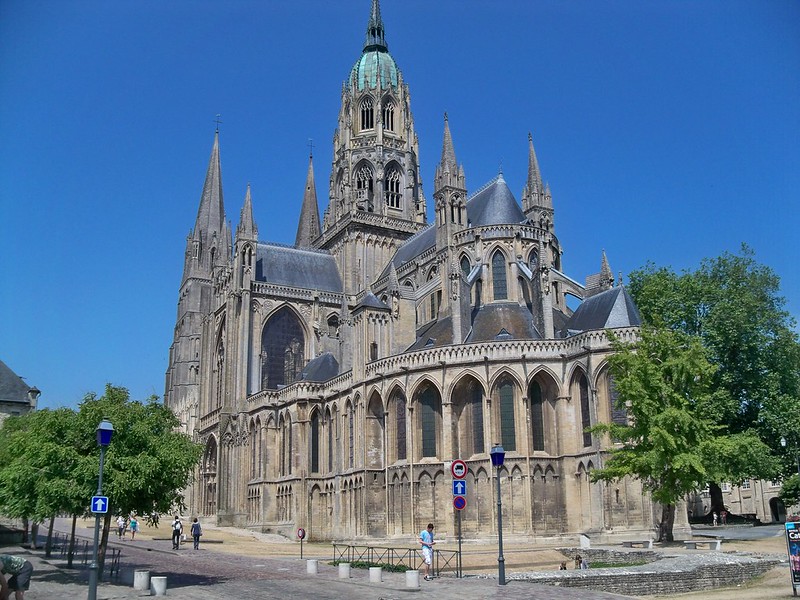
Bayeux Day Trip, Bayeux Cathedral

Bayeux Day Trip — Key Facts for 2026

30km from Caen · 45km from the Ouistreham ferry port · First French town liberated after D-Day, 7 June 1944 · Tapestry Museum closed until Oct 2027 · Tapestry itself in London Sept 2026–Jul 2027

Check Ferry Prices & Book Portsmouth to Caen →

🏰 Bayeux Day Trip at a Glance

30km
From Caen — around 30 minutes by car or train
70m
The length of the Bayeux Tapestry — actually an embroidery, not a woven tapestry
911 AD
The Treaty of Saint-Clair-sur-Epte — Rollo becomes ruler of Normandy
4,000+
British graves at Bayeux War Cemetery — the largest in France
  • ⚠️The Bayeux Tapestry itself cannot be seen in Bayeux in 2026 or the first half of 2027. The museum is closed for renovation until October 2027, and the Tapestry is on loan to the British Museum, London, from 10 September 2026 to 11 July 2027
  • Bayeux Cathedral — the Norman Romanesque cathedral where the Tapestry likely once hung, dedicated in 1077 in William the Conqueror’s own presence. Free, always open
  • Memorial Museum of the Battle of Normandy — unaffected by the Tapestry Museum closure, and the only museum covering the entire 77-day campaign. €8.50 adults
  • Bayeux War Cemetery — the largest British Commonwealth cemetery in France, over 4,000 graves. Free, open daily
  • The full Tapestry, viewable online — Bayeux Museum has published every scene in high-resolution detail, free, on bayeuxmuseum.com
  • Medieval old town — Bayeux escaped the destruction that levelled Caen, so its timber-framed houses and cobbled streets survive largely intact

The Bayeux Tapestry: What It Is and Why It Matters

The Bayeux Tapestry is one of the most famous surviving artefacts from medieval Europe — an extraordinary 70-metre embroidered account of the Norman Conquest of England in 1066, and the closest thing we have to a contemporary “news report” of one of the most consequential events in English history.

What Is the Bayeux Tapestry, Exactly?

Despite its name, the Bayeux Tapestry isn’t technically a tapestry at all — a true tapestry is woven on a loom, while this is an embroidery: coloured wool yarn stitched onto a base of linen cloth. It measures approximately 70 metres (230 feet) long and just 50cm high, telling its story across 58 numbered scenes with Latin captions, populated by around 626 human figures, 202 horses and mules, 55 dogs, and one famous depiction of Halley’s Comet, streaking across the sky as an omen shortly after Harold’s coronation.

The Tapestry is generally believed to have been commissioned by Bishop Odo of Bayeux — William the Conqueror’s maternal half-brother — and made in England in the 1070s, most likely by English embroiderers working in Kent, possibly using manuscript drawings from Canterbury as reference. It’s first definitively recorded in Bayeux in a 1476 cathedral inventory, though it may have hung there since the cathedral’s dedication in 1077. It was “rediscovered” by scholars outside Normandy in 1729, at a time when it was still being ceremonially displayed once a year in Bayeux Cathedral.

⚔️ What Battle Is Commemorated in the Bayeux Tapestry?

The Bayeux Tapestry tells the story of the Battle of Hastings, fought on 14 October 1066, and the events leading up to it — Harold Godwinson’s visit to Normandy and his oath to support William’s claim to the English throne, Edward the Confessor’s death, Harold’s coronation as king, and William’s cross-Channel invasion. It ends, famously, with the death of King Harold — traditionally shown struck in the eye by an arrow, though historians still debate whether that particular figure is Harold at all.

🧵 Who Actually Made It?

Nobody knows the individual embroiderers’ names. What scholars are confident about is that it was made in England, not France, despite having lived in Bayeux for most of its existence — the style of the Latin lettering, the drawing style, and specific design parallels with Canterbury manuscripts all point to an English workshop, quite possibly staffed largely by skilled Anglo-Saxon needlewomen, working to a Norman patron’s commission within a few years of the Conquest itself.

📖 Reading the Bayeux Tapestry

Reading the Bayeux Tapestry works much like reading a comic strip: follow the main band left to right, scene by scene, using the Latin captions (tituli) as your guide. But look at the borders too — the upper and lower strips are filled with Aesop-style fables, everyday rural life, and, in the battle scenes, an increasingly graphic parade of the dead and looted armour, which many historians read as a silent secondary commentary on the cost of the war unfolding in the main panel above.

Where Can You See the Bayeux Tapestry in 2026?

This is the single most important practical question for anyone planning a Bayeux day trip in 2026 — and the honest answer is more complicated than most older travel guides will tell you.

Not in Bayeux, Not Until October 2027

The Bayeux Tapestry Museum closed its doors on 1 September 2025 for a €38 million renovation and expansion, designed by British architects RSHP (Rogers Stirk Harbour + Partners), intended to let the Tapestry finally be displayed in a single continuous length rather than the cramped U-shape the old building forced on it. The new museum is due to reopen in October 2027, timed to mark the 1,000th anniversary of William the Conqueror’s birth. Until then, the historic Bayeux Tapestry Museum building itself is inaccessible to visitors.

The Tapestry itself was carefully removed from its display case in September 2025 — the first time it had been taken down since 1983 — and, after conservation work, will be lent to the British Museum in London from 10 September 2026 to 11 July 2027, the first time it has been on British soil since it was made almost 1,000 years ago. It then returns to Normandy to await the new museum’s opening.

🇬🇧 See It in London Instead

If your trip falls between September 2026 and July 2027, the British Museum is genuinely your best (and only) chance to see the real Tapestry. Demand has been extraordinary — tickets for the initial September to December 2026 window sold out entirely, with further release windows for January–March 2027 (bookings opened October 2026) and April–July 2027 (bookings opened January 2027). Book directly at britishmuseum.org as soon as a window opens if this matters to your trip.

💻 View Every Scene Online, Free

Bayeux Museum has published the entire Tapestry online in exceptionally high-resolution detail, scene by scene, free to browse at bayeuxmuseum.com — genuinely worth doing before or instead of an in-person visit, since it lets you zoom in closer than glass display cases usually allow. It’s the single best “reading the Bayeux Tapestry” resource available while the physical original is unavailable in Normandy.

🧵 See a Full-Size Replica in England

A remarkable Victorian full-scale replica, hand-embroidered in 1885–86 by Elizabeth Wardle and 37 fellow needlewomen from the Leek School of Art Embroidery, is on permanent display at Reading Museum in Berkshire, England — a genuine, if lesser-known, alternative to seeing the original, and worth knowing about if a trip to Bayeux or London isn’t on the cards.

🎪 “Bayeux Around Britain”

Alongside the London exhibition, the British Museum has organised a nationwide programme of related displays, including a full-scale facsimile at Tewkesbury Abbey and further exhibits linked to the story at sites including Hastings Museum — worth checking if you’re UK-based and can’t get London tickets.

Rollo of Normandy & Poppa of Bayeux: The Viking Roots of the Town

Long before the Bayeux Tapestry was stitched, Bayeux already had a central role in the story that made Normandy “Norman” in the first place — one that began not with William the Conqueror in 1066, but with a Viking warlord more than 150 years earlier.

Rollo: The Viking Who Became Normandy’s First Ruler

Rollo of Normandy — probably a Latinisation of the Old Norse name Hrólfr — was a Scandinavian Viking leader, likely from Norway or Denmark (sources disagree), who spent years raiding up and down the Seine valley in the late 9th and early 10th centuries, at one point taking part in the great Viking siege of Paris. By 911, the Frankish king Charles III (“the Simple”) judged it cheaper to make peace than keep fighting: under the Treaty of Saint-Clair-sur-Epte, Rollo was granted the lands around Rouen — soon to be called Normandy, “land of the Northmen” — in exchange for his baptism and a promise to defend the region against further Viking raids. Rollo is traditionally regarded as the first ruler of Normandy, though the title “Duke” wasn’t formally used by his line until decades later. His direct descendants ruled Normandy for over two centuries, and his great-great-great-grandson was William the Conqueror himself.

Our own sources for Rollo are shaky by modern standards — most of what’s “known” comes from Dudo of Saint-Quentin, a chronicler writing roughly a century later, commissioned by Rollo’s own grandson to record a flattering official history. Treat the more colourful details (a foot-kissing ceremony that supposedly went comically wrong; a prophetic dream of a mountain and a cleansing river) as legend layered onto a real historical figure, rather than verified fact. Rollo is buried today in Rouen Cathedral alongside his son William Longsword — you can read more about the cathedral and its other Norman and Plantagenet tombs on our Rouen Day Trip guide.

Poppa of Bayeux: The Town’s Own Place in the Story

This is where Bayeux specifically enters the story. According to Dudo’s account, Rollo took control of Bayeux by force sometime before 911, and there took Poppa of Bayeux — said to be the daughter of a regional count, Berenger — as his wife “more danico” (by Norse custom, rather than a full Christian rite). Their son, William Longsword, succeeded Rollo as the second ruler of Normandy, making Poppa the direct ancestress of every subsequent Duke of Normandy, including William the Conqueror. Some medieval sources claim Rollo later also married a Frankish princess, Gisela, as part of the 911 treaty, then returned to Poppa after Gisela’s early death — though many historians doubt Gisela existed at all. Poppa’s own precise parentage is similarly uncertain. What’s not in doubt is that Bayeux, not Rouen, is where the Norman ducal bloodline itself began.

What Else to See on a Bayeux Day Trip

Even without the Tapestry, Bayeux has enough to comfortably fill a full day — and, unusually for Normandy, a town centre that still looks much as it did centuries ago.

⛪ Bayeux Cathedral (Cathédrale Notre-Dame de Bayeux)

A genuine gem of Norman architecture, dedicated in 1077 in the presence of William the Conqueror himself — the same year the Tapestry is traditionally said to have first been displayed here. The cathedral’s Romanesque towers and crypt survive from that original building, with a soaring Gothic nave and choir added in later centuries. Free to visit, open daily, right at the heart of the old town.

🎖️ Bayeux Battle of Normandy Museum

The Memorial Museum of the Battle of Normandy is entirely unaffected by the Tapestry closure and remains one of the best D-Day-adjacent museums in the region — the only one covering the full 77-day Battle of Normandy campaign (7 June to 29 August 1944) day by day, with uniforms, vehicles, weapons and a 25-minute film. Admission: €8.50 adults, €6.50 reduced, €5 school/student, free under 10. Hours: 9:30am–6:30pm May–September; 10am–12:30pm and 2–6pm the rest of the year. Closed 5–18 January 2026 inclusive, and part-days around Christmas and New Year. Address: Boulevard Fabian Ware, 14400 Bayeux. A combined ticket covering both this museum and the MAHB is available at either desk — worth asking about if you’re visiting both, since the old three-museum combo no longer applies while the Tapestry Museum is closed.

🕊️ Bayeux War Cemetery & Memorial

The largest Commonwealth war cemetery in France, with over 4,000 graves — predominantly British, alongside servicemen of many other nationalities and, unusually for a CWGC site, some German graves too. Opposite stands the Bayeux Memorial, inscribed with 1,800 names of the missing. Free, open daily. Full detail on our Normandy Cemeteries guide.

🎨 MAHB — Baron Gérard Museum of Art and History

Bayeux’s fine art and local history museum, covering porcelain, lace, paintings and archaeology — a quieter, less crowded stop than the Battle of Normandy Museum, and a pleasant change of pace. Address: 37 rue du Bienvenu, 14400 Bayeux, a short walk from the cathedral.

🧵 Bayeux Broderie

A small embroidery shop near the closed Tapestry Museum, selling kits and offering lessons so you can stitch your own piece in the Tapestry’s distinctive style — a genuinely charming, hands-on way to engage with the Tapestry story while the original is unavailable to view in Normandy. Seasonal opening, so check ahead if this is a priority.

🏘️ The Medieval Old Town

Bayeux was the first French town liberated after D-Day, on 7 June 1944, and — almost uniquely among Normandy’s larger towns — escaped serious wartime damage. The result is a genuinely well-preserved medieval centre: timber-framed houses, a working watermill, and the Aure river running gently through the middle of town, with a pleasant riverside walking and cycling trail. Bayeux also holds a weekly market in the old town, a good opportunity for local produce and a proper feel for everyday Norman life.

Getting to Bayeux from Caen

Bayeux is one of the easiest Normandy day trips to reach without a car, thanks to a direct, frequent rail line from Caen.

🚂 By Train — The Easy Option

Frequent direct trains run from Caen to Bayeux — approximately 20 minutes, several times an hour at peak times. This is genuinely one of the simplest rail day trips in the region, and the station is a walkable 10–15 minutes from the cathedral, museums and old town centre.

🚗 By Car — 30km, ~30 Minutes

From Caen: take the N13 west toward Cherbourg, exit at gate 36 — approximately 30km, 30 minutes, toll-free. From the ferry port at Ouistreham: continue on the N13 past Caen — approximately 45km, around 45 minutes.

Combine with the beaches: Bayeux sits almost exactly between Gold Beach (10km) and Omaha Beach (15km), making it the natural midpoint for a day combining the town with either British or American D-Day sites. Further afield: Château de Creully, a 15-minute drive away, has its own D-Day connection — the BBC broadcast news of the Battle of Normandy from its tower in June 1944 — and makes a good detour if you have extra time.

Sample Bayeux Day Trip Itinerary

Two ways to structure a Bayeux day trip depending on whether you want to stay in the town all day or combine it with the beaches.

Bayeux Town — A Full Day

Perfect for: History and architecture-focused visitors happy to spend the whole day in the town itself.

  • 09:30: Train or drive from Caen (20–30 minutes)
  • 10:00: Bayeux Cathedral (free, allow 45 minutes)
  • 11:00: Old town walk along the Aure river, MAHB museum if time allows
  • 12:30: Lunch in the old town
  • 14:00: Memorial Museum of the Battle of Normandy (€8.50, allow 1.5–2 hours)
  • 16:00: Bayeux War Cemetery and Memorial (free, allow 30–45 minutes)
  • 17:00: Return to Caen (20–30 minutes)

Bayeux + Gold Beach — Combined Day

Perfect for: Combining the town with the British D-Day sector, since Bayeux sits almost exactly between Caen and Gold Beach.

  • 09:00: Drive to Bayeux from Caen (30 minutes)
  • 09:30: Cathedral and old town (allow 1.5 hours)
  • 11:15: Bayeux War Cemetery (30 minutes, free)
  • 12:00: Lunch, then drive to Arromanches (10km, 15 minutes)
  • 13:30: Gold Beach and the Mulberry Harbour remains (2–3 hours)
  • 17:00: Return to Caen via Bayeux (~40 minutes)

Top Tips for Your Bayeux Day Trip

  • Don’t plan your trip around seeing the Tapestry in Bayeux in 2026: it simply isn’t there. If seeing the original matters to you, plan around a British Museum visit (September 2026–July 2027) or wait until the new Bayeux museum opens in October 2027.
  • Book British Museum tickets the moment a release window opens: the first window sold out completely. Sign up to the British Museum’s newsletter for advance notice of future releases if you’re set on seeing it in London.
  • Browse the Tapestry online before you travel: Bayeux Museum’s free high-resolution online version (bayeuxmuseum.com) is genuinely excellent preparation, and arguably a better close-up view than most in-person visits allow.
  • Buy Battle of Normandy Museum tickets on arrival, not online: the museum only sells tickets on-site at the desk — there’s no advance booking option.
  • Bayeux is genuinely walkable: the cathedral, both remaining museums, the cemetery and the old town are all within 15–20 minutes of each other on foot — you won’t need a car once you’ve arrived.
  • Come back after October 2027 if the Tapestry is the priority: the new museum promises to display the full 70 metres in a single continuous run for the first time ever, rather than the old U-shaped layout — arguably a better viewing experience than existed before the closure, and worth returning for.

Bayeux Day Trip: Frequently Asked Questions

Where is the Bayeux Tapestry?

Normally, the Bayeux Tapestry is kept and displayed at the Bayeux Tapestry Museum in Bayeux, Normandy, France. However, the museum has been closed since 1 September 2025 for renovation and won’t reopen until October 2027. From 10 September 2026 to 11 July 2027, the Tapestry itself is on loan to the British Museum in London — the first time it has left Normandy in almost 1,000 years. It then returns to Bayeux to await the new museum’s opening.

What is the Bayeux Tapestry?

The Bayeux Tapestry is a 70-metre embroidered cloth, made in England in the 1070s, telling the story of the Norman Conquest of England in 1066, culminating in the Battle of Hastings. Despite its name, it’s technically an embroidery rather than a woven tapestry — coloured wool yarn stitched onto linen. It’s considered one of the most important surviving artefacts of the medieval world and a rare example of secular art from the period.

How long is the Bayeux Tapestry?

The Bayeux Tapestry is approximately 70 metres (around 230 feet) long and just 50cm high — a long, narrow strip rather than a large wall-hanging. It’s told across 58 numbered scenes, making it one of the longest surviving pieces of medieval art of its kind.

Who made the Bayeux Tapestry?

The individual embroiderers’ names aren’t known, but the Tapestry is generally believed to have been commissioned by Bishop Odo of Bayeux, William the Conqueror’s maternal half-brother, and made by English needleworkers, most likely in Kent, in the 1070s. Design similarities with Canterbury manuscripts support an English origin, despite the Tapestry’s long association with the French town whose name it carries.

Where can you see the Bayeux Tapestry right now?

Between September 2026 and July 2027, the only place to see the original is the British Museum in London — tickets have been in extremely high demand, with the first release window selling out completely. Outside that window (and until the new Bayeux museum opens in October 2027), the Tapestry isn’t on public display anywhere. A free, high-resolution scene-by-scene version is viewable online at bayeuxmuseum.com, and a full-size Victorian replica is permanently on display at Reading Museum in England.

What is on the Bayeux Tapestry?

The Tapestry depicts the events leading up to the 1066 Norman Conquest of England: Harold Godwinson’s journey to Normandy and his oath to William, the death of King Edward the Confessor, Harold’s coronation, the appearance of Halley’s Comet as an omen, William’s Channel crossing, and finally the Battle of Hastings itself, ending with the death of King Harold. Around 626 human figures, 202 horses and 55 dogs appear across its 58 scenes, with decorative borders full of animals, fables and — in the battle scenes — the discarded weapons and armour of the dead.

Where was the Bayeux Tapestry made?

Despite being named after — and displayed in — the French town of Bayeux for centuries, the Tapestry was almost certainly made in England, most likely in Kent, possibly at or near Canterbury, in the 1070s. It’s thought to have been brought to Bayeux specifically for its cathedral, likely commissioned by the Bayeux-born Bishop Odo, William the Conqueror’s half-brother.

Why is the Bayeux Tapestry in France if it was made in England?

It’s generally believed the Tapestry was commissioned specifically for Bayeux Cathedral by Bishop Odo of Bayeux, so although it was likely embroidered by English hands, it may always have been intended to end up in Normandy. It’s definitively recorded in a Bayeux cathedral inventory in 1476, and has remained associated with the town — with a handful of exceptions, including its current 2026–27 loan to London — ever since. It’s owned today by the French state, not the town of Bayeux itself.

Is Bayeux worth visiting, even with the Tapestry unavailable?

Yes. Bayeux is one of the best-preserved medieval towns in Normandy — its cathedral, timber-framed old town and riverside walks are worth the trip on their own, Tapestry or not. Add in the Battle of Normandy Museum, the largest British war cemetery in France, and the town’s genuinely central position for reaching the D-Day beaches, and Bayeux earns its place on a Normandy itinerary regardless of what’s happening with the Tapestry Museum in any given year.

How do you get from Caen to Bayeux?

The easiest way is by train — frequent direct services run from Caen to Bayeux in around 20 minutes, with the station a 10–15 minute walk from the old town centre. By car, take the N13 west toward Cherbourg and exit at gate 36; the drive takes about 30 minutes, toll-free. Both options are straightforward enough that a car isn’t necessary just to visit Bayeux itself, though one helps if you’re combining the town with the D-Day beaches on the same day.

Was Bayeux damaged during the Second World War?

No, remarkably little — Bayeux was the first French town liberated after D-Day, on 7 June 1944, and was captured largely intact, sparing it the destruction that levelled Caen and many other Normandy towns during the wider campaign. This is exactly why its medieval cathedral, timber-framed houses and cobbled streets survive today in a way few other towns on the D-Day coast can match.

How far is Bayeux from the D-Day beaches?

Bayeux sits almost exactly between the British and American D-Day sectors, making it one of the most central bases on the whole coast. Gold Beach (Arromanches) is around 10km away, Omaha Beach around 15km, and Pointe du Hoc around 30km — all comfortably reachable in a single day trip, which is why so many visitors choose to stay in or visit Bayeux specifically as their gateway to the beaches.

How much time do you need in Bayeux?

A half-day (around 3–4 hours) covers the cathedral, old town and one museum comfortably. A full day lets you add the Battle of Normandy Museum, the war cemetery, and a relaxed lunch without rushing. If you’re combining Bayeux with Gold or Omaha Beach on the same day, budget a half-day for the town itself and treat the beach visit as a separate block of time.
Continue Planning Your Normandy Visit

Gold Beach

10km from Bayeux — the Mulberry Harbour remains at Arromanches, the natural pairing for a combined day

Gold Beach →

🇺🇸

Omaha Beach

15km from Bayeux — the Normandy American Cemetery and the story of “Bloody Omaha”

Omaha Beach →

🕊️

Normandy Cemeteries

The six essential war cemeteries of the D-Day coast, including Bayeux War Cemetery — our complete guide

Normandy Cemeteries →

🏛️

Mémorial de Caen

The world’s finest D-Day museum, 30km from Bayeux — the ideal companion visit for a Normandy history day

Mémorial de Caen →

Plan Your Bayeux Day Trip — Travel via Portsmouth to Caen

Brittany Ferries sails year-round from Portsmouth to Caen (Ouistreham). From the ferry terminal, Bayeux is approximately 45 minutes by car or a short train ride via Caen — a beautifully preserved medieval town, D-Day history, and the deep Norman roots that connect them both.

Check Prices & Book Portsmouth to Caen →