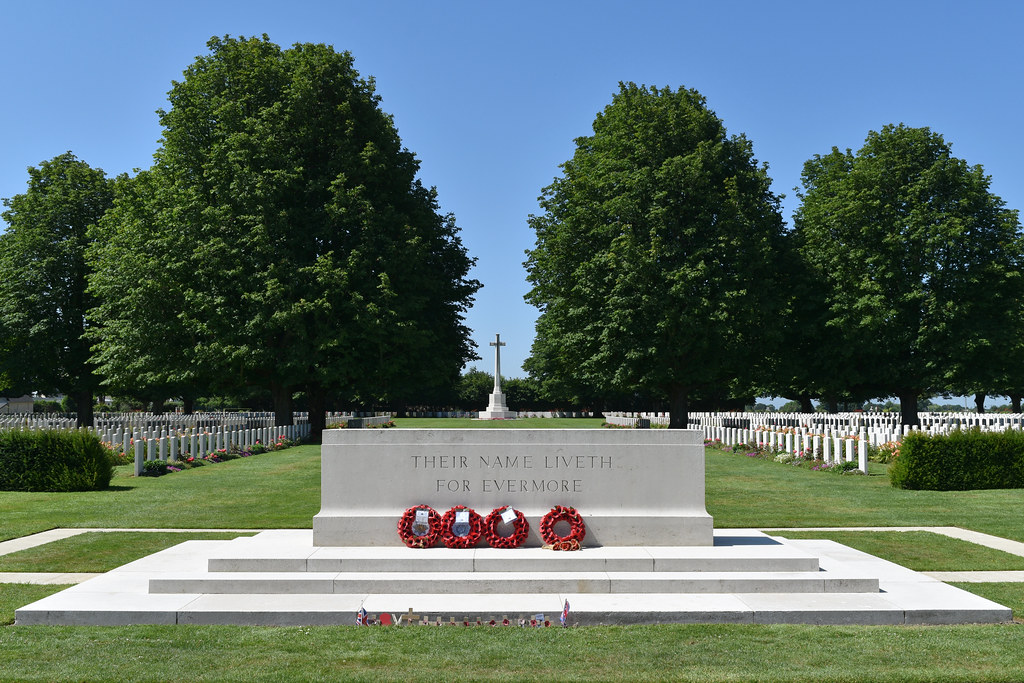
Normandy cemeteries hold the true scale of D-Day and the Battle of Normandy in a way no museum quite can. The Commonwealth War Graves Commission alone maintains graves at more than 300 locations across four Normandy departments, including 27 major military cemeteries, while the American and German war graves authorities maintain several more of their own. Each nation buries and commemorates its dead differently — a difference in stone, design and language that says as much about the war as any exhibit. This guide covers the six essential Normandy cemeteries most visitors prioritise, all free to visit and each within an hour or so of Caen.
D-Day cemeteries in Normandy fall into three distinct traditions. American war graves — white marble crosses and Stars of David at the Normandy American Cemetery — are the most photographed. Commonwealth war cemeteries, maintained by the CWGC, use uniform headstones inscribed with each soldier’s own faith or none, scattered across dozens of smaller sites close to where the fighting actually happened. German war cemeteries, maintained by the Volksbund, take a deliberately different form — dark stone, mass graves, and a tone of quiet reckoning rather than triumph. Visiting more than one of these traditions in a single day gives a far more complete picture of the human cost of Operation Overlord than any single site can offer alone.
This complete guide to Normandy’s war cemeteries covers everything you need to plan a respectful, well-informed visit in 2026: the six cemeteries most worth prioritising, what makes each one distinct, practical visiting information and etiquette, how to trace an individual soldier’s grave, and sample itineraries that combine cemeteries with the D-Day beaches themselves.
Last updated: July 2026 | Facts verified from the Commonwealth War Graves Commission, the American Battle Monuments Commission, the Volksbund Deutsche Kriegsgräberfürsorge and primary sources.