Rouen Day Trip: The Complete 2026 Visitor Guide

A Rouen day trip takes you to Normandy’s historic capital — a genuinely magnificent medieval city on the Seine, home to one of France’s greatest Gothic cathedrals, the site of Joan of Arc’s execution, and a beautifully preserved old town nicknamed the “city of a hundred spires.” Rouen is around 120km from Caen and roughly 130km from the Portsmouth to Caen ferry terminal at Ouistreham — an hour and twenty minutes by car, or a comfortable train ride, making it an easy full-day trip from either.

Rouen France has been a place of consequence for well over a thousand years: settled by Romans, then Vikings, it became the capital of Normandy when the Vikings became Normans in the 10th century. William the Conqueror held court here; Richard the Lionheart was crowned Duke of Normandy in the cathedral and, at his own request, had his embalmed heart buried there. Most famously of all, it was in Rouen’s Old Market Square that Joan of Arc was tried, condemned and burned at the stake in 1431 — a story that still shapes the city’s identity today.

This complete guide to a Rouen day trip covers everything: the extraordinary Rouen Cathedral France and its connection to Claude Monet, the full story of Joan of Arc in Rouen and the sites that mark it, what to see and do around the old town, the famous Rouen Christmas market, and how to get there from Caen.

Last updated: July 2026 | Facts verified from Rouen Tourisme, Normandy Tourism and primary historical sources.
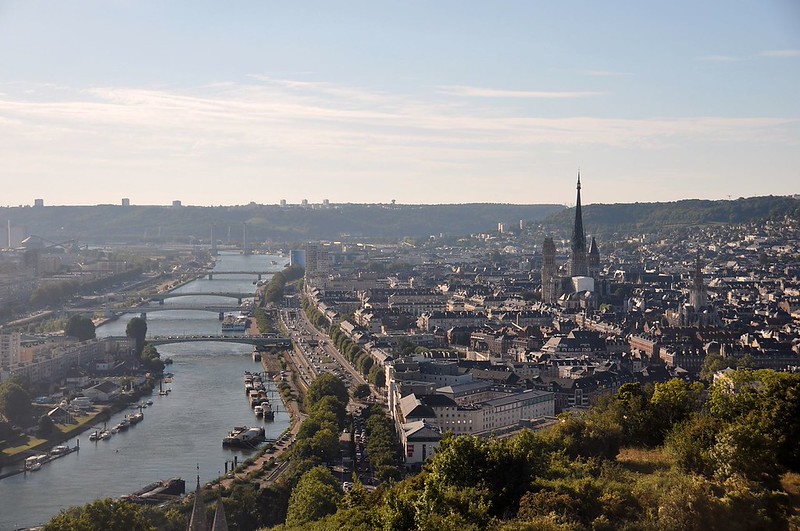
Rouen Cathedral and Town. Rouen Day Trip

Rouen Day Trip — Key Facts for 2026

120km from Caen · 130km from the Ouistreham ferry port · ~1h20 by car or direct train · Tallest building in the world, 1876–1880 · Joan of Arc executed here, 1431 · Christmas market late Nov–early Jan

Check Ferry Prices & Book Portsmouth to Caen →

⛪ Rouen Day Trip at a Glance

120km
From Caen — around 1 hour 20 minutes by car or direct train
FREE
Rouen Cathedral, the Church of Joan of Arc and the old town streets
151m
Height of the cathedral spire — the tallest church in France
1431
The year Joan of Arc was tried and executed in Rouen
  • Rouen Cathedral — the Gothic masterpiece Monet painted more than 30 times, and the tallest building in the world from 1876 to 1880. Free entry
  • The Church of Joan of Arc — built on the exact site of her execution in 1431. Free entry
  • Gros Horloge — the medieval astronomical clock at the heart of the old town, one of France’s finest
  • Aître Saint-Maclou — a genuinely unsettling medieval plague cemetery, carved with skulls and crossbones
  • ⚠️Visiting for Christmas? The Rouen Christmas market is one of the best in France, but the city gets genuinely busy — see the dedicated section below for exact dates and tips

The History of Rouen: City of a Hundred Spires

Rouen has been a major settlement on the Seine since Roman times, but its defining transformation came with the Vikings — and the deal that turned raiders into rulers.

From Viking Stronghold to Ducal Capital

When the Viking leader Rollo was granted the lands around Rouen by the French king in 911, the city became the capital of the new Duchy of Normandy, and it remained the region’s political and religious heart for centuries afterward. William the Conqueror held court in Rouen regularly, and Richard the Lionheart — Duke of Normandy and King of England — was crowned Duke here in Rouen Cathedral. When Richard died in 1199, following the custom of the time, his body was buried in three places: his heart, specifically, was embalmed and interred in Rouen Cathedral at his own request, a mark of the special affection he held for the city.

Rouen’s medieval wealth came from the Seine itself — a vital trading link between Paris and the English Channel that made the city one of France’s great commercial centres, and left it with the dense, richly decorated old town of half-timbered houses and Gothic churches that still defines it today. Despite serious damage during Allied bombing in 1944, much of that historic fabric survived or was carefully restored, and Rouen remains, alongside Bayeux, one of the best places in Normandy to experience genuine medieval streetscapes.

👑 A Royal Affection

Rouen’s ties to the English crown ran deep for centuries — a legacy of the shared Anglo-Norman world that followed 1066. Successive English and French kings maintained a genuine attachment to the city, and it’s said that Richard the Lionheart’s request to have his heart buried in Rouen Cathedral specifically, rather than alongside the rest of his body, reflected exactly that bond. Richard isn’t the only Norman ruler entombed there, either: the cathedral also holds the tombs of Rollo — the Viking leader whose 911 deal with the French king founded Normandy in the first place — and his son William Longsword, the second ruler of Normandy. We tell Rollo’s fuller story, including his marriage to Poppa of Bayeux, on our Bayeux Day Trip guide.

🏛️ La Couronne — France’s Oldest Inn

On the Place du Vieux-Marché, in the shadow of the Church of Joan of Arc, stands La Couronne — an inn dating back to 1345, and generally recognised as the oldest in France. Behind its half-timbered façade, the original wood-beamed ceilings and leaded windows survive, and it still operates as a working restaurant today. It has a claim to fame well beyond its age, too: American chef Julia Child reportedly ate her first proper French meal here in 1948, an experience she later credited with sparking her lifelong passion for French cuisine — and the restaurant still serves the signature local dish she had that day, canard au sang (Rouen-style duck, pressed and served in a rich blood-thickened sauce), alongside menus from around €29 to €83 per person.

Rouen Cathedral: Monet’s Muse

Rouen Cathedral France (Cathédrale Notre-Dame de Rouen) is, quite simply, one of the great Gothic buildings of Europe — and one whose fame extends well beyond architecture into the history of modern art itself.

The Tallest Building in the World

Built and rebuilt over more than 800 years, Rouen Cathedral blends Early Gothic, Flamboyant Gothic and Renaissance architecture, and is instantly recognisable for its three mismatched towers, each in a different style. The central lantern tower, topped by a cast-iron spire completed in 1882 after decades of controversy over the design, reaches 151 metres — still the tallest church spire in France today. For a brief window, from 1876 to 1880, it was the tallest building anywhere in the world, before being overtaken by Cologne Cathedral.

The cathedral has suffered its share of disasters over the centuries — struck by lightning in 1822, badly damaged by Allied bombing in 1944 — and, most recently, a fire broke out on the scaffolded spire during renovation work in July 2024. The fire turned out to be minor, burning only protective plastic sheeting rather than the structure itself, and the cathedral reopened within days; the building and its artworks were untouched. It remains fully open to visitors today. From May to September, the west façade also hosts a free evening light and sound show, projecting animated illuminations across the stonework after dark — a striking, no-cost way to see the building again once the day-trip crowds have gone.

Claude Monet’s Obsession

In the winters of 1892 and 1893, Claude Monet rented rooms directly across from the cathedral’s west façade and painted it more than 30 times, capturing the same view in shifting light, weather and seasons — one of the most exhaustive series of his career, and a landmark moment in Impressionism. Rather than depicting the cathedral’s famous spire, Monet focused almost entirely on the western portal, using thick, layered brushstrokes to make solid stone seem to dissolve into colour and atmosphere. The paintings are now scattered across the world’s great museums, from the Musée d’Orsay in Paris to the National Gallery of Art in Washington, D.C. — with one on permanent display much closer to home, at the Rouen Museum of Fine Arts.

Joan of Arc in Rouen

No single story shapes Rouen’s identity more than Joan of Arc’s, and the city still holds the exact sites where it unfolded.

Trial, Execution and Rehabilitation

Captured by Burgundian forces in 1430 and sold to their English allies, Joan of Arc was brought to English-controlled Rouen and tried for heresy before a pro-English church court headed by Bishop Pierre Cauchon, beginning in January 1431. Her central “crime,” according to the tribunal, was claiming direct divine guidance over the authority of the Church — compounded by her insistence on wearing men’s clothing. Found guilty and sentenced as a relapsed heretic, she was burned at the stake in the Old Market Square (Place du Vieux-Marché) on 30 May 1431, aged just 19. Her ashes were scattered into the Seine from the old Pont Mathilde so that no relics could be kept.

Twenty-five years later, at the request of her mother and with the Pope’s approval, a rehabilitation trial was held in Rouen — remarkably, in the same archiepiscopal complex beside the cathedral where she had originally been condemned. In 1456, the original verdict was formally annulled and Joan declared innocent; in 1920, the Catholic Church canonised her as a saint. She remains one of France’s most powerful national symbols, and Rouen marks the anniversary of her death every year on the last Sunday of May, with flowers thrown into the Seine from the Boieldieu Bridge at the point where her ashes were scattered.

⛪ The Church of Joan of Arc

Completed in 1979 on the exact site of the Old Market Square, the Church of Saint Joan of Arc (Église Sainte-Jeanne-d’Arc) is a striking piece of modern architecture — its sweeping, asymmetric roofline was deliberately designed to evoke both the flames of Joan’s execution and an overturned Viking longship, a form borrowed from some of Christianity’s earliest churches. The adjoining market halls echo the same shape, doubling as stylised upturned boats. A small garden beside the church, called Le Bûcher (“The Pyre”), marks the precise spot of the execution.

✝️ The Joan of Arc Memorial Cross

A tall iron cross in the Cross of Lorraine style, rising around 20 metres beside the Church of Joan of Arc, stands on the site identified by archaeological evidence as the exact spot of her execution — visible above the surrounding rooftops from several directions across the square.

🎭 Historial Jeanne d’Arc

Housed in the Archiepiscopal Palace beside the cathedral — the very building where both of Joan’s trials took place — this immersive museum uses projections, holograms and 3D mapping to walk visitors through her trial, in a genuinely unusual and highly rated format. Admission: €11 adults, €8 reduced. Hours: Tuesday–Sunday, 10am–7pm, last entry 5:15pm; closed Mondays. Tour takes around 75 minutes, plus additional time for the parts of the building outside the guided route.

🏰 Tour Jeanne d’Arc

A different, less-visited part of Joan’s story: this surviving tower is almost all that remains of the castle built by King Philippe Augustus after he drove the English out of Normandy in the early 13th century. When the English retook control during the Hundred Years’ War, Joan of Arc was held and threatened with torture inside this very tower, distinct from both the execution site and the Historial museum. It’s now home to an escape-room experience, giving the building an unusual second life alongside its heavy history.

What to See and Do in Rouen

Beyond the cathedral and Joan of Arc’s story, wondering what to see in Rouen beyond the headline sights? The old town rewards a good few hours of simply wandering.

🕰️ Gros Horloge

An elaborate Renaissance astronomical clock, mounted on an arch spanning Rouen’s main pedestrianised shopping street — one of France’s most photographed medieval monuments, and the spine connecting the Old Market Square to Cathedral Square. You can climb the belfry itself for panoramic views over the old town’s rooftops (small admission charge).

💀 Aître Saint-Maclou

One of the most striking surviving medieval plague cemeteries in Europe — a half-timbered courtyard whose wooden beams are carved with skulls, crossbones and gravedigger’s tools, built after the Black Death overwhelmed the city’s other burial grounds. Look closely at one of the beams and, according to local tradition, you may spot a mummified cat, sealed into the woodwork centuries ago. Free, open access, genuinely atmospheric.

⚖️ Palais de Justice

A magnificent Flamboyant Gothic law court, one of the finest civic buildings in Normandy, with an ornately carved façade that rewards a slow look from the square in front of it. Still in use as a working court today, so interior access is limited, but the exterior alone is one of Rouen’s architectural highlights.

🖼️ Musée des Beaux-Arts

Rouen’s Museum of Fine Arts holds one of the Monet Rouen Cathedral paintings on permanent display, alongside a strong wider collection spanning several centuries — a natural companion visit after seeing the real cathedral outside, letting you compare the building with Monet’s version of it.

The Old Town & the Rouen Pass

Rouen is nicknamed the “city of a hundred spires” for good reason — beyond the cathedral, the Gothic churches of Saint-Maclou and Saint-Ouen are both worth a look, and the streets between them are lined with genuinely well-preserved half-timbered houses rather than the reconstructions found in some other Normandy towns. Rouen also takes its food seriously — in 2021 it became the first French city awarded UNESCO “City of Gastronomy” status — and if you want to eat well beyond La Couronne, Restaurant L’Odas holds a Michelin star and is well worth booking ahead for. At weekends, the Place Saint-Marc and Place du Vieux-Marché host Rouen’s two most emblematic markets, and the Marché des Saveurs on Rue Eugène Boudin runs every Saturday morning. If you’re planning to visit several paid sites, the Rouen Pass bundles guided tours, museum and monument access and unlimited public transport into a single ticket — worth checking if your day includes more than one or two paid attractions.

Rouen Christmas Market

The Rouen Christmas market — officially branded “Rouen Givrée” — is consistently ranked among the best in France, and transforms the old town into something genuinely magical each winter.

🎄 What to Expect

The main market sits on Place de la Cathédrale, right in front of Rouen Cathedral, with wooden chalets selling handmade gifts, mulled wine, crêpes and Norman specialities. Beyond the market itself, more than 80 streets and sites across the city are lit up for the season, a Ferris wheel on the Place du Vieux-Marché offers panoramic views over the illuminated rooftops and cathedral towers, and over 150 street performances take place through Advent. Recent editions have run from late November to early January (2025’s ran 21 November to 4 January, branded “Rouen Givrée”), with a full programme of workshops, concerts, an ice rink, and a Viking encampment event at the Aître Saint-Maclou in the run-up to Christmas — check en.visiterouen.com for exact 2026 dates closer to the time.

The market is free to wander, with most activities and food stalls priced individually. If you’re combining the market with a cathedral visit, evenings are especially atmospheric, when the illuminated old town and the floodlit cathedral both come into their own — though this is also when crowds are at their thickest.

Getting to Rouen from Caen

Rouen is genuinely easy to reach from Caen by either road or rail — one of the more flexible day trips on this site.

🚗 By Car — 120km, ~1h20

From Caen: take the A13 motorway east — approximately 120km, around 1 hour 20 minutes. The A13 uses free-flow tolls (no barriers; number-plate cameras bill you automatically, payable online within 72 hours at sanef.com, which fully supports UK-registered vehicles).

From the ferry port at Ouistreham: continue past Caen on the same route — approximately 130km, around 1 hour 30 minutes.

🚂 By Train — A Genuinely Good Option

Rouen Rive Droite station has direct connections from Caen, and the station itself is only around a 10-minute walk from the cathedral and old town centre — genuinely one of the more convenient rail day trips covered on this site. The same station also connects directly to Le Havre, Dieppe, Vernon-Giverny and Paris Saint-Lazare (around 1 hour 30 minutes), making Rouen easy to combine with other destinations if you’re travelling onward.

Combine with Giverny: Since both sit on the same Paris rail line and the A13 corridor, Rouen and Monet’s garden at Giverny pair naturally for visitors wanting a fuller day of art and history together.

Sample Rouen Day Trip Itinerary

Rouen’s essential sites cluster closely enough together that a full, satisfying day is entirely realistic without rushing.

A Full Day in Rouen

Perfect for: Covering the cathedral, Joan of Arc’s story and the old town in one well-paced day.

  • 09:30: Arrive (1h20 by car or train from Caen); Rouen Cathedral (free, 45 minutes)
  • 10:30: Musée des Beaux-Arts to see the Monet cathedral painting (allow 1 hour)
  • 11:45: Walk Rue du Gros-Horloge to the clock tower itself (free to view, small charge to climb)
  • 12:30: Lunch on or near Place du Vieux-Marché
  • 13:45: Church of Joan of Arc and the Old Market Square (free, 30 minutes)
  • 14:30: Historial Jeanne d’Arc (€11, allow 1.5 hours)
  • 16:15: Aître Saint-Maclou and a wander through the half-timbered streets (free, 45 minutes)
  • 17:15: Return to Caen (1h20 by car or train)

Top Tips for Your Rouen Day Trip

  • The train is genuinely a great option here: unlike most day trips on this site, Rouen’s station sits close enough to the old town that you can happily leave the car behind — worth considering if you’d rather avoid city-centre parking.
  • Book Historial Jeanne d’Arc tickets online in busy periods: it’s closed Mondays, and the 75-minute guided format means slots can fill up on peak summer days.
  • Visit the cathedral at different times of day if you can: given Monet’s whole series was about how the light changes the building’s appearance, seeing it in morning versus late-afternoon sun genuinely does show you something different.
  • If visiting for the Christmas market, book accommodation early and expect crowds: Rouen Givrée is genuinely popular, and weekend evenings in December get very busy around the cathedral square.
  • Consider the Rouen Pass if your day includes several paid sites — it bundles transport and admission together at a better combined price than paying separately.
  • Combine with Giverny or Étretat: Rouen’s position on the A13 corridor and the Paris rail line makes it a natural pairing with Monet’s garden at Giverny, or a full coastal day continuing on to the cliffs at Étretat.

Rouen Day Trip: Frequently Asked Questions

Where is Rouen?

Rouen is the historic capital of Normandy, France, situated on the River Seine roughly midway between Paris and the English Channel. It’s approximately 120km from Caen and 130km from the Portsmouth to Caen ferry terminal at Ouistreham (around 1 hour 20 minutes by car or direct train), and about 135km — roughly 1 hour 30 minutes by train — from Paris.

Is Rouen worth visiting?

Yes, without question. Rouen combines one of France’s finest Gothic cathedrals, the extraordinary and moving story of Joan of Arc, a genuinely well-preserved medieval old town, and — in December — one of the country’s best Christmas markets. It’s easily reached from Caen by car or direct train, and rewards a full day rather than a rushed half-day stop.

What to see and do in Rouen?

The essentials are Rouen Cathedral, the Church of Joan of Arc and the Old Market Square, the Gros Horloge astronomical clock, the Aître Saint-Maclou medieval plague cemetery, and the Historial Jeanne d’Arc museum. Add the Musée des Beaux-Arts to see one of Monet’s cathedral paintings in person, and simply wandering the half-timbered streets between the main sights — much of what to do in Rouen genuinely is a compact old town, easily covered on foot in a single day.

What is Rouen famous for?

Rouen is best known for three things: Rouen Cathedral, painted more than 30 times by Claude Monet and once the tallest building in the world; the trial and execution of Joan of Arc in 1431, which took place in the city’s Old Market Square; and its exceptionally well-preserved medieval old town, nicknamed the “city of a hundred spires.” It’s also increasingly known for its Christmas market, regularly ranked among the best in France.

Why was Joan of Arc executed in Rouen?

Rouen was the military and administrative capital of English-controlled Normandy in 1431, which is why Joan of Arc — captured by Burgundian forces and sold to the English — was tried there rather than in her own diocese. A pro-English church court found her guilty of heresy, largely over her claim of direct divine guidance and her refusal to stop wearing men’s clothing, and she was burned at the stake in the city’s Old Market Square on 30 May 1431. The verdict was annulled twenty-five years later, and she was declared a saint in 1920.

Is Rouen Cathedral still open after the 2024 fire?

Yes. A fire broke out on the scaffolded spire during renovation work in July 2024, but it burned only protective plastic sheeting rather than the cathedral’s structure, and the building reopened within days with no damage to the cathedral itself or its artworks. It remains fully open to visitors, free of charge, and renovation work has continued since.

Continue Planning Your Normandy Visit

🎨

Giverny

Claude Monet’s house and water garden, on the same rail line and motorway corridor as Rouen

Giverny Guide →

🪨

Étretat

Dramatic chalk cliffs and natural arches, less than an hour north of Rouen

Étretat Guide →

Honfleur

The birthplace of Impressionism, on the same Norman coast between Caen and Rouen

Honfleur Guide →

🏖️

All D-Day Beaches

Complete hub covering all five D-Day landing beaches, with distances from Caen and our interactive map

D-Day Beaches Hub →

Plan Your Rouen Day Trip — Travel via Portsmouth to Caen

Brittany Ferries sails year-round from Portsmouth to Caen (Ouistreham). From the ferry terminal, Rouen is approximately 1 hour 30 minutes by car or a direct train ride — Normandy’s historic capital, and one of the finest cathedral cities in France.

Check Prices & Book Portsmouth to Caen →