Driving in France from Caen: The Complete UK Driver’s Guide 2026

Driving in France from Caen puts you in a very specific position: within two kilometres of a D-Day beach, fifteen kilometres from the city William the Conqueror built, and at the beginning of one of France’s main toll motorway corridors heading east toward Rouen and Paris. Unlike arriving at a westerly Brittany port, where toll-free roads stretch ahead for hours, stepping off the ship at Ouistreham means you’ll likely encounter a péage barrier within the first thirty minutes — and sections of the A13 toward Paris now operate as free-flow, with no barriers at all. Miss the payment and you face a fine. This guide covers everything UK drivers need for driving in France from Caen and Normandy: French road rules, speed limits, the Normandy toll network, mandatory equipment, fuel, breakdown procedures, and the best routes to drive from Ouistreham.

Last updated: June 2026 | Information verified from RAC, official French government sources, Brittany Ferries and the Caen Mémorial. French law changes regularly — verify current requirements before travel.

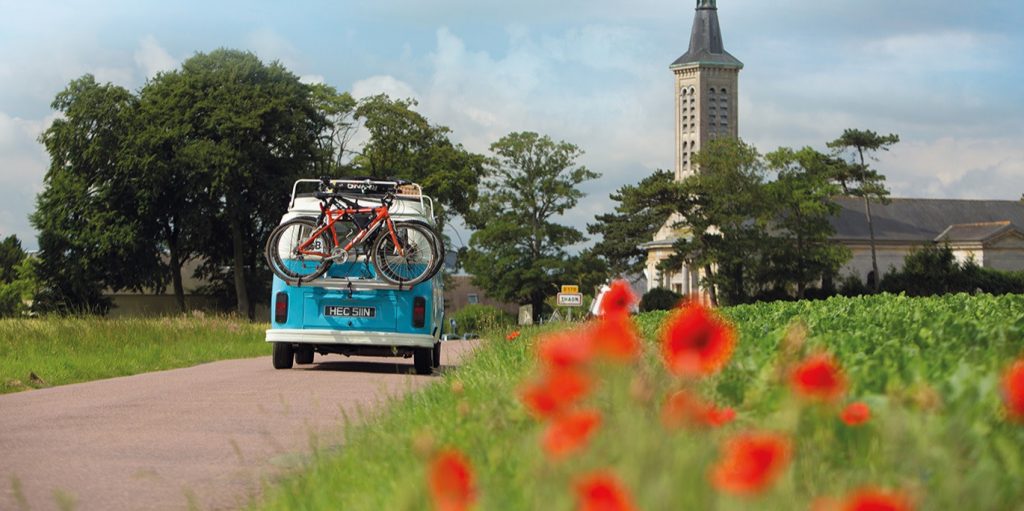
Driving in France from Caen Guide, Campervan driving through Normandy

🚗 Driving in France from Caen — Fast Facts for UK Drivers

130 kph
Motorway limit (~80 mph)
80 kph
Rural roads (~50 mph)
0.05%
BAC drink-drive limit
A13
Tolled — starts near Caen
  • Drive on the right, overtake on the left — begin as you leave the port, not when you feel ready
  • Hi-viz vest mandatory — one per person, kept inside the car; never in the boot
  • Warning triangle required — 30 metres behind on regular roads, never on motorways
  • Headlight beam deflectors required — UK right-hand drive lights dip left and dazzle oncoming drivers
  • ⚠️ A13 free-flow sections — no barriers — cameras read your plate; pay online within 72 hours or face surcharges
  • Radar detectors and GPS camera alerts completely illegal — fine up to €1,500 and confiscation

Book Your Crossing with Brittany Ferries

Your First Miles from Ouistreham — What to Expect

Coming off the ship at Port de Ouistreham is a different experience to any other UK ferry arrival. You are not in a port city. You are at the mouth of the Canal de Caen à la Mer, a small port town, with the Normandy coast stretching away on either side. Sword Beach — one of the five Allied landing beaches of June 1944 — is a two-minute drive from the terminal gate. The D514 coastal road to the east and west will start appearing on your sat nav before you’ve even cleared the port. Most UK drivers turn immediately toward Caen, 15km south, or hit the A13 northeast toward Rouen and Paris. A péage barrier is likely within your first half hour on the road — and unlike anywhere else you arrive from a UK ferry, some A13 sections have no barriers at all.

Let the flow of ferry traffic clear first. When a full crossing disembarks, the road from the terminal to the D514 and toward Caen can be briefly busy with vehicles all heading the same direction. Pull off somewhere safe near the port exit, properly sort your headlight beam deflectors if you haven’t fitted them on board, double-check your dashboard is showing kph not mph, and let the main tide of vehicles get clear. The five minutes this costs saves a more stressful start.

Drive on the right from the very first metre. This sounds obvious, but the moments of genuine confusion don’t come on the long straight roads — they come when you pull away from a lay-by, out of a petrol station forecourt, or onto a quiet Norman lane where your instincts override your intentions. Say it out loud if it helps in the first few junctions. A sticky note on the dash reading “KEEP RIGHT” is not overly cautious; it’s what experienced European drivers still use after a long overnight crossing when attention is softer.

Set your sat nav to kph before you move. Speed in France is measured and enforced in kilometres per hour throughout — not just on motorways. Key conversions: 50 kph ≈ 31 mph, 80 kph ≈ 50 mph, 110 kph ≈ 68 mph, 130 kph ≈ 80 mph. Most modern devices switch easily — do it while you’re still parked near the port, not while moving toward a camera on the D514.

Overnight arrivals: arriving fresh in France at 06:45 or 07:30. The overnight 23:00 sailing from Portsmouth arrives in Ouistreham at either 06:45 or 07:30 French local time (France is one hour ahead year-round — your phone updates automatically). If you’ve been drinking on board and plan to drive at arrival, bear in mind France’s drink-drive limit is 0.05% BAC — considerably lower than England’s 0.08%. The safest approach after any drinking is not to drive until you’re confident you’re under the limit.

Normandy is an excellent region to ease into French driving. The roads around Ouistreham and along the Calvados coast are well-maintained, generally well-signposted, and largely quiet outside peak summer. The first thirty minutes after Ouistreham — whether you head down the D514 coast road toward the D-Day beaches or south toward Caen — are ideal for settling in before pushing any pace. There is no rush. History, cheese, cider, and some of the finest driving in northern France are immediately ahead of you.
Speed Limits in France — 2026

French speed limits apply on every road you’ll drive from Ouistreham. They’re consistently enforced with fixed cameras, mobile units, and unmarked police vehicles — and on-the-spot fines payable immediately in euros are handed out at the roadside without the option of paying later. Two things catch UK drivers out more than any others: limits that drop automatically in rain, and the fact that entering a town means 50 kph without any separate speed limit sign.

Road Type Dry Wet / Rain Approx. MPH (dry)
Toll motorway (Autoroute / Péage) 130 kph 110 kph 80 mph
Dual carriageway / Express highway 110 kph 100 kph 68 mph
Rural roads (outside built-up areas) 80 kph 80 kph 50 mph
Urban / built-up areas 50 kph 50 kph 31 mph
Near schools / some town centres 20–30 kph 20–30 kph 12–18 mph

⚠️ The Settlement Name IS the Speed Limit Sign

The 50 kph limit takes effect the instant you cross a settlement name sign — there is no separate speed limit indicator as you’d see in the UK. The crossed-out name at the far end of the village signals the restriction has ended. Normandy has hundreds of small villages along the D-road network — many approached on roads with no advance warning. Watch for name signs.

📸 Speed Camera Enforcement in Normandy

Fixed cameras operate on the D514 coast road and on routes through Caen. The A13 has both fixed and free-flow cameras. Mobile units and unmarked gendarmerie vehicles operate across the region including quiet D-roads. France and the UK have a mutual fine recovery agreement — a penalty incurred in Normandy will follow you home. Exceeding the limit by more than 40 kph risks your licence being confiscated at the roadside.

🌧️ Wet Weather Speed Reductions

When it rains, motorway limits drop from 130 to 110 kph and dual carriageway limits from 110 to 100 kph. Rural and town limits remain unchanged. The reduction applies as soon as rainfall begins — not only when roads are visibly wet. Normandy’s Atlantic-influenced climate means rain arrives frequently even in summer, and these reduced limits are actively enforced.

🚫 Radar Detectors & GPS Speed Camera Alerts — Illegal in France

Any device capable of warning you of speed cameras is banned in France — including radar detectors sitting switched off in the glovebox, and GPS speed camera alert features on sat navs and phones. Fines reach €1,500 and the device or vehicle can be confiscated. Before you leave the ship: turn off “speed camera alerts”, “safety cameras”, or equivalent in every device you carry. If your device allows it, removing the French camera database entirely is the safest solution. The correct legal mode is “danger zones” — which alerts to general areas of danger rather than specific fixed camera locations — though even this is subject to interpretation. When in doubt, disable all camera-related features entirely.

Documents to Carry When Driving in France

You will go through French border control (Police aux Frontières) as you drive off the ship at Ouistreham — passports out and ready before you reach the vehicle deck. After that, gendarmerie stops are common on main routes through Caen and on the approach to Bayeux and the D-Day sites, particularly in summer. Keep all documents together in a single wallet in the glovebox — not buried in a boot bag you can’t access at a roadside stop.

1

Valid Passport

Required at Portsmouth check-in, UK Border Force departure control, and immediately on disembarkation at Ouistreham where French border officials check passports. Every passenger including children and infants requires their own — no one can be added to a parent’s passport. Your passport must have been issued within the last 10 years and have at least three months’ validity beyond your planned return date. Keep passports to hand in the vehicle for the border check at the port exit.

2

Full UK Driving Licence

Your current UK photocard driving licence is recognised throughout France — no International Driving Permit is required for photocard holders. If you still hold an old-style paper licence, you will need an IDP (£5.50 from PayPoint locations across the UK). Police can issue a €38 fine if you cannot produce your licence at a stop, rising to a potential €750 fine if you fail to present it within five days at a police station.

3

V5C Vehicle Registration Document

Carry your V5C (or VE103 if driving a hire car). French police can ask for evidence that you own the vehicle or have authorisation to drive it. If you’re borrowing someone else’s car, carry a signed letter from the registered keeper confirming their permission — this is good practice that avoids complications at a stop.

4

Proof of Insurance

You must carry evidence of at least third-party insurance covering France. Check your policy before travel — many UK comprehensive policies reverted to third-party only in EU countries following Brexit. Contact your insurer to confirm the level of cover. A Green Card is no longer legally required in France but your insurer will provide one free of charge on request, and it makes an excellent supplement at a stop or after an accident.

5

MOT Certificate

Carry your current MOT if your vehicle is more than three years old. French police rarely ask for it at a routine stop, but having it available confirms your vehicle is roadworthy. Check that your MOT won’t expire during your time in France — if it falls due within the next month, renewing before travelling removes the risk of an expired certificate while abroad.

💡 Prescription glasses: If you need spectacles or contact lenses to drive, French law requires you to carry a spare pair of glasses in the vehicle. A fine applies if you are stopped without them. Store them in the glovebox before you leave home — not in a bag in the boot that you can’t access while driving.

Mandatory Equipment for UK Vehicles Driving in France

Beyond your paperwork, your vehicle must carry specific equipment that French law requires. Fines for missing items reach €135 per item. The Guillaume de Normandie and Mont Saint Michel both carry headlight beam deflectors and UK identifier stickers in the onboard boutique — useful if you’ve forgotten either. Everything else needs to be in the car before you board in Portsmouth.

🦺 Hi-Visibility Vest — Mandatory

One CE-marked hi-viz vest per person in the vehicle — not one for the driver, one each. Anyone leaving the car at a roadside stop must wear one before stepping outside.

Never stow them in the boot. You put them on before you get out, not after — which means by the time you realise you need one at a motorway breakdown, it’s already too late to retrieve it from the boot. Back seat, door pockets, glovebox. Fine up to €135 per person for not wearing one when required.

⚠️ Warning Triangle — Mandatory

Must be in the vehicle at all times. If you break down or have an accident on a regular road, place it well behind the vehicle — approximately 30 metres back — to give approaching drivers adequate warning.

Do not place a warning triangle on a French motorway. On the A13 or any autoroute, the procedure is different — use the orange emergency phones on the hard shoulder instead and wait behind the crash barrier. Fine up to €135 for not carrying one.

💡 Headlight Beam Deflectors — Mandatory

UK right-hand drive headlights dip to the left — on a French right-hand road this aims them at oncoming drivers. Beam deflector stickers redirect the dip and are legally required for UK vehicles in France.

Available from the boutique on both ships — buy them before the ship arrives at Ouistreham if you haven’t brought your own, then fit them before you drive off. Remove them when you return to the UK or they will dazzle UK drivers.

🔵 UK Identifier — Mandatory

Your vehicle must display “UK” on the rear when driving in France. If your number plate already shows the UK flag and “UK” lettering, no separate sticker is needed.

The old “GB” sticker has not been valid since September 2021. If you have one from before Brexit, replace it before this trip — using a GB sticker is now incorrect.

🌿 Crit’Air Pollution Sticker — Essential for Caen

Caen city centre has a low-emission zone (ZFE). If you plan to drive into Caen itself, you need a Crit’Air sticker. Order only from certificat-air.gouv.fr — avoid unofficial third-party sites that charge inflated prices for the same sticker. Cost around £4, allow at least 10 days for delivery to a UK address.

Ouistreham port itself does not require a Crit’Air sticker for direct port access. But if your route takes you into Caen, Rouen, or other Norman cities, you’ll need one. Fine for non-compliance: €135 for cars.

🔦 Spare Bulbs — Strongly Recommended

Not compulsory under current French law for cars, but if a bulb fails, police can stop you from continuing until it is replaced. A small bulb kit takes up almost no space and costs very little. Note: LED headlights are not field-replaceable — police understand this and do not expect you to carry LED spares.

🔲 Tyre Tread Depth

The legal minimum tread depth in France is 1.6mm — the same as the UK. French police and gendarmerie can check tyres at a roadside stop and issue on-the-spot fines for non-compliance. Check all four tyres before you travel, particularly if you are driving significant distances across Normandy or onto the A13 toward Paris.

📷 Dashcams

Legal to use in France for personal recording — unlike some EU countries, dashcams are not prohibited. However, publicly sharing footage that shows identifiable number plates or individuals without consent is restricted under French privacy law. This is not a concern for personal insurance use, only for sharing on social media or posting online.

French Road Rules UK Drivers Need to Know

The structure of French driving is largely logical — but the rules that differ from home are the ones that generate fines and, occasionally, collisions. Know these before you reach the D514 roundabout outside Ouistreham.

↕️ Priorité à Droite — Know This Before You Leave the Port

At many unmarked junctions across France, vehicles from the right have priority even when you are on what appears to be the main road. This is the rule that generates the most genuine confusion for UK drivers, particularly on D-roads, in village centres, and at older junctions without signage.

Learn the key signs: a yellow diamond means you currently hold priority. A yellow diamond with a black diagonal stripe through it means priority has ended — at the next unsigned junction, yield to anything from your right. If there are no signs at a junction at all, assume priorité à droite and yield.

Main roads (Routes Nationales), A-roads, and autoroutes are clearly signposted. The moment you leave these for a smaller D-road or enter a village, be alert. Normandy’s network of small roads between D-Day beach sites and market towns rewards slow, attentive driving.

🔄 Roundabouts

The vast majority of modern French roundabouts work as they do in the UK — traffic already circulating has priority, you yield when entering, giving way to your left. The Ouistreham port exit roundabout works this way.

Some older roundabouts in rural Normandy still apply priorité à droite, which reverses the rule — entering traffic has priority over circulating traffic. Always look for a triangular give-way sign or the yellow diamond. When signage is absent or ambiguous, slow down and be prepared to yield.

🍷 Drink-Drive Limit — 0.05% BAC

France’s legal limit is 50 mg per 100 ml — notably lower than England and Wales’s 80 mg limit. For newly qualified drivers and professionals the limit drops further to 20 mg/100ml. Random roadside checks are routine throughout Normandy, particularly around tourist areas in summer.

On the overnight crossing, if you were drinking in the evening and plan to drive at arrival — into Caen by 07:00 French time — alcohol may still be in your system. The simplest and safest rule is no alcohol at all the night before an early morning drive.

Breathalysers: France no longer requires drivers to carry a disposable breathalyser since the law was repealed in January 2020. You will not be penalised for not having one.

📵 Mobile Phones & Headphones

All mobile phone use while driving is banned — and unlike in the UK, this ban explicitly extends to hands-free use via earpieces or Bluetooth earbuds. Navigation by voice on a fixed-mount device is permitted; active call use is not.

Headphones and earphones are separately banned while driving in France — including a single earbud in one ear. Fine: €135. This is one of the genuine rule differences from the UK that most drivers don’t know until they’re stopped.

🪑 Seatbelts & Child Seats

Every person in the vehicle must wear a seatbelt at all times — no exceptions. Children under 10 must travel in a suitable child seat or restraint matched to their weight and age, and cannot sit in the front seat unless the rear seats are occupied by other children under 10 or the car has no rear seats.

Rear-facing infant seats may only be used in the front passenger position with the airbag deactivated. UK-purchased approved child seats comply with European standards and are valid in France.

🚗 Motorway Lane Discipline & Road Signs

Keep to the right lane on French motorways unless overtaking — middle-lane driving is an offence. On the A13 toward Rouen and Paris, this is strictly observed.

Triangular signs with a red border are warnings. Circular signs with red borders are prohibitions. Blue circles are mandatory instructions. The word “Rappel” on a sign means “reminder” — the previous limit or restriction continues. A single solid white centre line in France carries the same no-overtaking meaning as a UK double white line — do not cross it.

Toll Roads from Caen — The A13 and What UK Drivers Need to Know

Arriving at Caen is fundamentally different from arriving at a westerly port. If you dock at Roscoff, you drive into largely toll-free Brittany and may not encounter a péage for your entire trip. From Ouistreham, the main route east — toward Rouen, Paris, and beyond — joins the A13 autoroute, one of France’s most significant toll corridors. Parts of the A13 and A14 between Caen and Paris now operate as free-flow: no barrier, no booth, cameras read your plate automatically. Without a toll tag, you must pay online within 72 hours. Miss the window and fines accumulate.

The A84 heading south from Caen toward Avranches and Mont Saint-Michel is toll-free. The N13 north toward Cherbourg is toll-free. Caen to Bayeux via the D613 is toll-free. It is only when you head northeast on the A13 that tolls begin — but that is the most natural onward route for many passengers arriving from Portsmouth.

📷 Free-Flow on the A13/A14 — No Barriers

Certain sections of the A13 and A14 between Caen and Paris have no physical toll barriers. Cameras read your vehicle registration at motorway speed. If you have a toll tag, payment is automatic. If you don’t, you must pay online at ulys-autopay.fr or at a tabac or service station terminal within 72 hours of using the section.

Unpaid free-flow tolls attract a surcharge and eventual fine. UK number plates are read and registered by the system — failure to pay does not go unnoticed or unrecorded.

🎫 Conventional Ticket-and-Pay Péage

On sections where barriers remain, take a ticket on entry and pay at the exit booth. Credit cards are accepted at staffed booths and most automated lanes. Keep your ticket — losing it can mean paying the maximum fare for that section.

All toll booths are designed for left-hand drive cars — the booth is on your nearside, which for a UK vehicle means the passenger side. You’ll need to lean across, open the door, or use a toll tag. Travelling with a passenger makes this easier; solo UK drivers find a tag considerably more convenient.

📡 Toll Tag — Most Convenient for A13 Users

A toll tag (télépéage) — such as an Emovis or Bip&Go sticker on your windscreen — is automatically read as you pass through dedicated “t” lanes, works on free-flow sections, and removes the need to fumble at a booth designed for the wrong side of the car. Payment goes directly to your bank account.

Order online — allow around 10 days for delivery. If you plan to drive the A13 corridor toward Rouen or Paris, or make multiple trips, a tag is a straightforward investment. Use viamichelin.com to estimate toll costs for your specific route before you travel.

What Vehicle Class Are You? — Toll Pricing Categories

Class Height Weight (GVW) Typical vehicles
Class 1 Under 2m Under 3.5t Standard cars, SUVs, estates, MPVs — the majority of UK vehicles
Class 2 2–3m Under 3.5t Campervans, motorhomes under 3m, cars with caravans at 2–3m total height. ~50% more than Class 1
Class 3 Over 3m or over 3.5t Over 3.5t Larger motorhomes, HGVs. Approximately double Class 1
Class 5 N/A N/A Motorcycles, sidecars, tricycles

💡 Practical notes: Standard UK cars — including most SUVs and estate cars — are Class 1 (under 2 metres). A car towing a caravan where total combined height is 2–3 metres is Class 2 (around 50% more per toll). Exceeding 3 metres total height moves you into Class 3 at approximately double. Always carry euros as cash backup — not all automated toll machines reliably accept foreign-issued credit cards. Notify your bank you will be using the card in France before departure.

Towing a Caravan or Driving a Motorhome — Speed Limits in France

The speed limits that apply to your outfit depend on your combined gross train mass (GTM) — the total authorised weight of vehicle and caravan or motorhome when fully loaded. You’ll find this figure in your vehicle handbook or on a sticker inside the driver’s door jamb. This figure, not the weight of the caravan alone, determines your limits.

Road Type Under 3.5t GTM (dry) Under 3.5t GTM (wet) Over 3.5t GTM
Motorway (A13 etc.) 130 kph 110 kph 90 kph
Dual carriageway 110 kph 100 kph 90 kph
Rural roads 80 kph 70 kph 80 kph
Built-up areas 50 kph 50 kph 50 kph

Under 3.5 Tonnes GTM — Standard Limits Apply

Most UK touring caravans and campervans fall under 3.5 tonnes GTM — this means the same limits as a solo car: 130 kph on motorways. This is actually faster than the UK’s 60 mph (97 kph) towing limit. Confirm your specific GTM in your vehicle handbook before assuming this applies.

Over 3.5 Tonnes GTM — 90 kph Maximum

If your combined outfit exceeds 3.5 tonnes GTM, 90 kph is the maximum on all non-urban roads regardless of road type or whether you’re on the A13 motorway. Larger caravans towed by heavier vehicles can cross this threshold. Police cameras enforce it. Note also: passengers are not permitted to ride inside a caravan while in motion in France.

💡 Toll class when towing or in a motorhome: A car and caravan where combined height is between 2 and 3 metres is Class 2 at toll booths — approximately 50% more than a solo car. Exceeding 3 metres total height moves you to Class 3. Check your combined height with everything fitted (roof rack, solar panels, aerial) and use viamichelin.com to estimate A13 toll costs before you travel.

⛽ Fuel in France — Names, Grades and Where to Fill Up

French fuel names differ from UK names. Putting diesel in a petrol car — or vice versa — is a very expensive mistake that is considerably easier to make at an unfamiliar foreign pump than at your usual local garage. Read the pump label every single time before the nozzle goes in, not after.

🟢 Petrol (Unleaded)

French name: Essence or Sans Plomb

Grades: SP95 (standard unleaded), SP98 (premium, equivalent to UK Super Unleaded), SP95-E10 (10% ethanol blend — not suitable for all older vehicles; check your handbook).

Most modern petrol cars run correctly on SP95. If in doubt, SP98 is the safe option.

🟠 Diesel

French name: Gasoil or Gazole

Variants: Gazole B7 (standard diesel) and Gazole B10 (higher biofuel content — check your manual before using B10 in an older diesel).

Never rely on nozzle colour alone — read the pump label. Gasoil and Essence pumps are sometimes adjacent with similar-looking handles.

💶 Cheapest Fuel Near Caen and Normandy

Cheapest: Large supermarket and hypermarket forecourts — Leclerc, Carrefour, Auchan on the outskirts of Caen and Bayeux. Competition between major supermarkets typically keeps Normandy prices competitive.

Most expensive: A13 motorway service stations. Fill up in Caen or at a supermarket before joining the autoroute northeast. Motorway fuel can be significantly more expensive.

⛽ Misfuelling Warning

Misfuelling is easier to do at an unfamiliar foreign pump — particularly in the first hours after a long overnight crossing when you may be tired. Check the pump label before the nozzle goes in. If you do accidentally misfuel: switch the ignition off immediately and do not turn it back on. Call your breakdown provider before starting the engine — misfuelling caught before you drive is a service call; misfuelling discovered after you’ve driven is an engine repair.

Breaking Down in Normandy — What to Do

A breakdown in France is manageable with the right preparation — and significantly less stressful if you have European breakdown cover in place before you need it. The procedure differs depending on whether you are on a motorway or a regular road.

🛣️ On a Regular Road (D-road, N-road, or lay-by)

  1. Move as far off the road as possible and activate hazard lights immediately
  2. Put on your hi-viz vest before leaving the vehicle — every person who exits must wear one
  3. Place your warning triangle approximately 30 metres behind the car on approach
  4. Move all passengers and any pets well away from the road
  5. Call your breakdown provider. European emergency number: 112 — free from any phone with or without signal
  6. Stay away from the road while you wait

🛤️ On the A13 or Any French Autoroute

  1. Pull onto the hard shoulder — hazard lights on immediately
  2. Everyone leaves the vehicle via the nearside (passenger-side, away from traffic) doors only
  3. Vests on, move everyone beyond the crash barrier on the verge side
  4. Do not place a warning triangle on a French motorway — it is dangerous
  5. Use the orange emergency phones on the hard shoulder (orange pillars every 2km). These connect free of charge directly to motorway control and are tracked to your exact location
  6. Recovery on autoroutes must go through the motorway operator — your insurer will then handle the claim

💡 European breakdown cover: Your UK breakdown cover does not automatically extend to France. Check your policy before travel — RAC, AA, and Green Flag all offer European cover as an affordable add-on. If you break down on the D514 between beach sites, or on a Norman lane after dark, having cover arranged in advance is considerably more practical than dealing with it at the roadside in a foreign language.

🗺️ Where to Drive from Caen — Routes into Normandy and Beyond

Ouistreham puts you at the northern edge of Calvados, with D-Day history directly on your doorstep and some of the most rewarding driving country in northern France within an hour in every direction. The coast road, the D-Day sites, Bayeux, and the Normandy countryside are all remarkably accessible from here — and most routes west and south are free of tolls entirely.

⚔️ D-Day Beaches — Right Outside the Port

First road: D514 west along the coast from Ouistreham. Toll-free.

Sword Beach is 2km from the port exit — the first of the five Allied landing beaches, liberated by British and Free French forces on 6 June 1944. Drive west along the D514 and you reach Juno Beach (Courseulles-sur-Mer, 23km), Gold Beach (Arromanches, 36km), Omaha Beach (Colleville-sur-Mer, 60km), and Utah Beach (85km). The coastal road is scenic, slow-paced, and punctuated with memorials, museums, and cemeteries. Allow a full day. The Caen Mémorial de Caen, 15km south in the city, is an exceptional starting point for context before the beaches. D-day Beach/Cemetery Guide.

🏰 Bayeux — 30km West, Toll-Free

Route: D613 west from Caen to Bayeux. 30km. Approximately 35 minutes. No toll.

Bayeux survived the Second World War largely intact — which makes it a remarkable Norman medieval town to walk through given what happened to Caen around it. The Bayeux Tapestry (70 metres of 11th-century embroidery depicting William the Conqueror’s conquest of England) is the principal draw, housed in a purpose-built museum. Bayeux Cathedral dates from the 11th century. The Commonwealth War Cemetery on the northern edge of town is one of the most poignant sites in all of Normandy. A natural morning stop from Caen before heading to the beaches. Bayeux Guide.

🏙️ Caen City — 15km South

Route: D515 south from Ouistreham along the Canal de Caen à la Mer. 15km. Approximately 20 minutes. No toll.

Caen is William the Conqueror’s city — the Château de Caen, which he built in the 11th century, still stands at the centre of the modern city. The Abbaye aux Hommes (where William is buried) and the Abbaye aux Dames are both remarkable. The Mémorial de Caen is internationally regarded as one of the finest Second World War museums in Europe, with free parking and EV charging. Note that Caen city centre has a low-emission zone — a Crit’Air sticker is required to drive in. The D515 south follows the canal and is one of the most pleasant approaches into any Norman city. Caen city guide.

🏔️ Mont Saint-Michel — 90 Minutes South-West

Route: A84 south from Caen toward Avranches then N175. Approximately 130km. Toll-free on A84.

The A84 from Caen to Avranches is toll-free and one of the most convenient routes to Mont Saint-Michel from any UK ferry port. The famous tidal island abbey sits at the boundary of Normandy and Brittany — roughly 90 minutes from Ouistreham in clear traffic. Arrive early or late in the day to avoid the peak crowds of July and August. Parking is on the mainland; a shuttle or a tidal causeway walk takes you across. Mont Saint-Michel Guide.

⚓ Cherbourg & the Cotentin Coast — 90km North

Route: N13 north from Caen to Cherbourg. Toll-free throughout.

The N13 north from Caen passes through Bayeux and Carentan (Utah Beach area) before reaching the Cotentin Peninsula and Cherbourg. It is toll-free throughout and takes around 75 minutes to Cherbourg. The peninsula’s west coast from Barneville-Carteret to Cap de la Hague is spectacularly quiet — one of Normandy’s best-kept driving routes. Cherbourg itself has an excellent Cité de la Mer underwater museum and the submarine Le Redoutable.

🗼 Rouen, Paris & Beyond — A13 East

Route: A13 northeast from Caen toward Rouen (130km) and Paris (250km). Tolled — includes free-flow sections.

Honfleur — one of the most-visited towns in Normandy — sits just off the A13 at the Pont de Normandie bridge, around 75km from Caen. Its old harbour, slate-spired church, and Eric Satie connections make it a natural stopping point heading toward Rouen. Honfleur Guide.
Étretat is around 130km from Caen via the A13 and A29 — the chalk cliff arches, the Aiguille, and the Falaises d’Étretat are among the most photographed landscapes in France, and Monet painted them repeatedly. Budget 90 minutes from Ouistreham in clear traffic. Etretat Guide.
Rouen itself is also 90 minutes on the A13 — a large Norman city with a magnificent medieval quarter, Joan of Arc’s execution site, and the cathedral Monet painted obsessively. Rouen Guide.
Paris is around 2.5 hours from Caen in clear traffic. The A13 carries significant freight and tourist traffic — plan around Bison Futé red days in summer. Use viamichelin.com for current toll cost estimates before departure. Caen to Paris Guide.

🏔️ Falaise, Suisse Normande & Pays d’Auge — Inland Normandy

Routes: D562 south to Falaise (35km, 40 min). West toward Suisse Normande via Thury-Harcourt. D613 east toward Pays d’Auge. All toll-free.

Three of Normandy’s best inland drives, all within 45 minutes of Caen.
Falaise is William the Conqueror’s birthplace — his castle still stands above the town and makes a natural companion to the Abbaye aux Hommes in Caen.
Suisse Normande is a surprising landscape of river gorges and wooded valleys carved by the Orne, nothing like the coastal Normandy most visitors see; the road from Thury-Harcourt to Clécy is one of the best in the region.
Pays d’Auge east of Caen is classic Norman countryside — Camembert country, half-timbered farms, cider orchards, and the Route du Cidre between Cambremer and Beuvron-en-Auge. All three are toll-free and quiet outside peak summer weekends. Pays d’Auge Guide.

💡 Bison Futé — official French traffic forecasts: Before any long drive from Caen — particularly on the A13 in summer — check bison-fute.gouv.fr. This is France’s official traffic forecast service, colour-coded by direction and day (green through to black). Saturdays in July and August are the heaviest travel days on main routes south and east from Normandy — the A13 corridor can back up significantly around school holiday changeovers. Planning around these dates or travelling early in the morning makes a substantial difference.

Frequently Asked Questions — Driving in France from Caen

Do I need an International Driving Permit to drive in France from Caen?

No. A current UK photocard driving licence is fully valid in France — no IDP is needed for photocard holders. If you only have an old-style paper licence, you will need an International Driving Permit (£5.50 from PayPoint locations). Police can issue a €38 fine if you cannot produce your licence at a roadside stop.

Are there toll roads near Ouistreham and Caen?

Yes — unlike arriving at a Brittany port, driving northeast from Caen means joining the A13 autoroute, which is tolled and includes free-flow (barrier-free) sections toward Rouen and Paris. Without a toll tag on free-flow sections, you must pay online within 72 hours or face a surcharge. Routes west and south from Caen are largely toll-free: the D514 coast road, the D613 to Bayeux, the A84 to Mont Saint-Michel, and the N13 to Cherbourg all carry no toll charges.

What are the free-flow sections on the A13 and how do I pay?

Certain sections of the A13 and A14 between Caen and Paris have no physical barriers — cameras read your vehicle registration automatically at motorway speed. If you have a French toll tag (Emovis or Bip&Go), payment is handled automatically. Without a tag, you must pay within 72 hours at ulys-autopay.fr or at a terminal in a tabac or service station. Failing to pay results in a surcharge on top of the original toll. UK plates are fully recognised and tracked by the system.

What is the drink-drive limit in France?

The legal blood alcohol limit in France is 50mg per 100ml (0.05% BAC) — lower than the 80mg/100ml limit in England and Wales. For newly qualified drivers and professionals the limit is 20 mg/100ml. Random breath tests are common in Normandy, particularly in tourist areas during summer. If you’re driving off the overnight ferry at 06:45 or 07:30 after drinking on board, alcohol may still be present in your system. The safest approach is not to drink at all if you are driving on arrival.

Do I need a Crit’Air sticker to drive in Caen?

Yes, if you plan to drive into Caen city centre, which has a low-emission zone (ZFE). No sticker is required for direct port access at Ouistreham. The Crit’Air sticker is also needed in Rouen and other French cities you may pass through. Order only from certificat-air.gouv.fr (the sole official source — avoid unofficial sites charging inflated prices for the same sticker). Cost around £4; allow at least 10 days for delivery to a UK address.

What is priorité à droite and does it apply in Normandy?

Priorité à droite means vehicles approaching from the right have priority at many unsigned junctions — even when you’re on what appears to be the main road. It applies across France, including throughout Normandy on smaller D-roads and in village centres. A yellow diamond sign means you hold priority; a yellow diamond with a black diagonal stripe means priority has ended — yield to the right at the next unsigned junction. On A-roads, Routes Nationales, and autoroutes, priority is clearly signposted. On smaller roads, always be alert.

Can I use my phone hands-free while driving in France?

No. France bans all mobile phone use while driving — including hands-free calls via Bluetooth or earpieces. Voice-operated navigation on a fixed mount is permitted; call use is not. Wearing any headphones or earphones while driving is also prohibited in France, including a single earbud. Fine for phone or headphone use: €135.

Do I need to carry a breathalyser in France?

No — the law requiring drivers to carry a disposable breathalyser was repealed in France in January 2020. You will not face a fine for not having one. Some drivers still carry one voluntarily given France’s 0.05% BAC limit is notably lower than England’s 0.08% — entirely a personal choice.

What are the speed limits when towing a caravan from Caen?

It depends on your combined gross train mass (GTM — tow car plus caravan at maximum load). Below 3.5 tonnes GTM, standard French limits apply: 130 kph on the A13 motorway, 110 kph on dual carriageways, 80 kph on rural roads, 50 kph in towns. Over 3.5 tonnes GTM, the maximum drops to 90 kph on all non-urban roads. A car and caravan outfit is also classified as Class 2 at toll booths when combined height is 2–3m, meaning around 50% more than a solo car on A13 tolls.

Continue Planning Your Portsmouth to Caen Trip

🚗

Taking Your Vehicle on the Ferry

Prices, dimensions, check-in times, alarm advice, and everything vehicle passengers need for the crossing

Car Ferry Guide →

🏰

Caen City Guide

William the Conqueror’s city — the Château, Abbaye aux Hommes, Mémorial de Caen and where to park

Caen City Guide →

🗼

Caen to Paris

Driving the A13 from Ouistreham to Paris — toll costs, free-flow sections, Honfleur and Rouen stops

Caen to Paris →

⚔️

D-Day Beaches Guide

Sword, Juno, Gold, Omaha and Utah — driving the D514 coast road from Ouistreham with distances and stops

D-Day Beaches →

Ready to Book Your Portsmouth to Caen Crossing?

Your Normandy driving adventure begins the moment you drive off the ship at Ouistreham. Sword Beach is two kilometres from the port gate. Book early — summer sailings fill quickly.

Book with Brittany Ferries