Caen’s main attractions cluster in the city centre — the Château, both abbeys, the Quartier Vaugueux, and Église Saint-Pierre are all within walking distance of each other. The Mémorial de Caen is 15 minutes by bus (line 2) or a 45-minute walk north-west of the centre. Here is everything worth seeing, with verified 2026 admission prices.
Mémorial de Caen
€20.80 adult | €18.50 child (10–18) & senior (65+) | €53 family (2 adults + children 10–18) | €6 student/Caen resident | Under 10 FREE | Address: Esplanade Général Eisenhower, 14000 Caen | Bus: Line 2, direction Mémorial | Duration: Allow 4 hours minimum
The Mémorial de Caen is among the most important museums in Europe — a vast, immersive journey through the 20th century, the Second World War, and the D-Day landings, built on the very ground where the Battle of Normandy was fought in 1944. Inaugurated in 1988 on the site of a former German command bunker, the museum begins with the roots of the First World War and carries you through the rise of fascism, the occupation of France, the Resistance, the Holocaust, the D-Day landings, the 100 days of the Battle of Normandy, and the Cold War that followed — including fragments of the Berlin Wall, a thermonuclear bomb casing, and an original Enigma coding machine — one of the most striking individual objects in the museum. The D-Day exhibition uses a large split screen to show the landings simultaneously from Allied and German viewpoints — a device of extraordinary effect.
The museum gardens serve as a memorial to the international soldiers who gave their lives in Normandy in 1944 — American, British, Canadian, Polish, and Free French. Below the museum building, General Richter’s underground bunker — the German command post for Caen on D-Day — can be visited as part of the admission. The Mémorial also runs daily guided tours to the D-Day beaches in small groups, in English and French; book at the museum’s website at memorial-caen.com. Tickets are valid for 18 months from purchase.
💡 Ferry tip: If you are arriving from Portsmouth on the overnight sailing and disembarking at Ouistreham in the morning, the Mémorial opens at 9am. From Ouistreham port, take the Gare Maritime Express or Bus 12 to Caen centre (allow 20–35 minutes depending on which service you catch), then bus 2 to the Mémorial (a further 15 minutes) — or take a taxi directly from the port (allow €25–30). This is one of the most powerful ways to begin a Normandy trip.
Château de Caen
Ramparts: FREE | Musée de Normandie: from €5–7 depending on exhibitions | Musée des Beaux-Arts: from €3.50 | Under 26: FREE at both museums | First weekend of month: FREE for all | Address: Le Château, 14000 Caen | Note: No car access to the castle — use nearby car parks
The Château de Caen dominates the city from its hilltop position — a vast medieval fortress begun by William the Conqueror around 1060, whose walls and towers rise above a 5-hectare enclosure that is among the largest walled fortifications in Europe. The ramparts are free to walk at any time and offer panoramic views across Caen’s rooftops and the two abbeys William and Matilda built. The remains of the 12th-century Exchequer Hall (Salle de l’Échiquier) — where William’s court conducted its financial affairs — are among the most atmospheric ruins in Normandy. In 2026 the Salle de l’Échiquier hosts an immersive multimedia show tracing 1,000 years of Caen’s history through sound, light, and projection. The château and both abbeys are built from the distinctive blonde limestone quarried here for over a thousand years — pierre de Caen, or Caen stone. After the Conquest, William used the same stone to build the White Tower at the Tower of London in the 1070s: the most direct material connection between Caen and England that still stands.
Within the ramparts, two museums occupy the castle grounds. The Musée de Normandie — Norman history and ethnography from prehistory to the present — is housed in the former Governor’s residence. The Musée des Beaux-Arts holds a major collection of European paintings including a remarkable Flemish section (Rubens, Breughel, Van der Weyden), Italian Renaissance works, and French masters from Poussin to Courbet. Both museums are free for under-26s at all times, and free for all visitors on the first weekend of each month. The castle entrance is via the Porte Saint-Pierre (opposite Église Saint-Pierre) and the Porte des Champs. Allow 2–3 hours for the full site.
Abbaye aux Hommes & Abbaye aux Dames
Church of Saint-Étienne (Abbaye aux Hommes): FREE to enter | Guided tours of the cloister and abbey buildings: check caenlamer-tourisme.com for times and prices | Abbaye aux Dames: FREE, daily guided tours
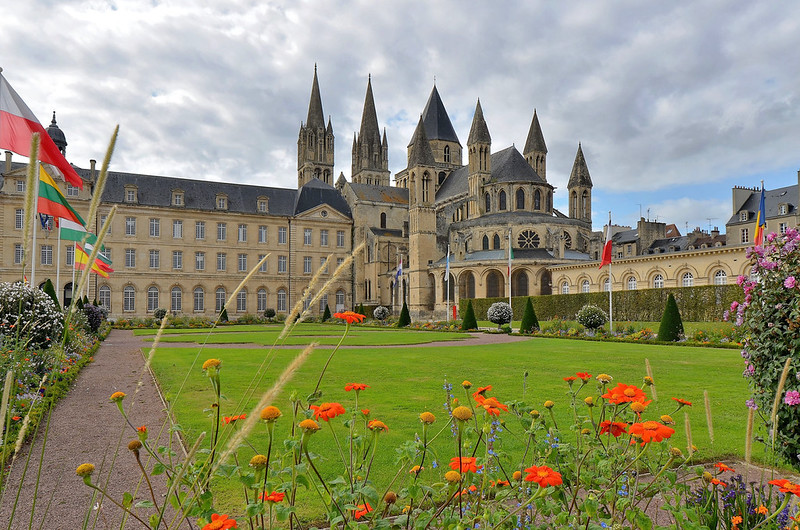
The two abbeys William and Matilda built in Caen — as penance for having married their distant cousin without papal permission — are the twin anchors of the city’s medieval identity and among the finest examples of Norman Romanesque architecture anywhere in the world. They directly inspired a generation of English cathedral builders after 1066.
The Abbaye aux Hommes (Men’s Abbey) — also known as the Abbey of Saint-Étienne — was founded by William in 1063. His tomb lies before the high altar in the abbey church, marked by a simple marble slab. The church is free to enter at any time. The 18th-century monastic buildings, now serving as Caen’s Hôtel de Ville (city hall), can be visited on guided tours that include the magnificent cloister, the refectory, and the chapter house. The guided tour runs at set times — check ahead at the tourist office as timings vary seasonally. The building is one of the most complete abbeys of its era in France.
The Abbaye aux Dames (Women’s Abbey), founded by Matilda of Flanders in 1062, is located at the opposite end of the city centre and is equally impressive. Her tomb is in the choir of the Abbaye de la Trinité church, and the guided tours — offered daily, free of charge — reveal the complete Romanesque nave and the 18th-century convent buildings now occupied by the Normandy Regional Council. The two abbeys together constitute one of the greatest paired monastic complexes to survive from the 11th century.
Quartier Vaugueux, Église Saint-Pierre & the Old Town
FREE to explore | Location: Rue du Vaugueux and surrounding streets, Caen city centre
The Quartier Vaugueux is Caen’s most atmospheric medieval quarter — a compact neighbourhood of half-timbered Norman houses, cobbled lanes, and evening restaurants that survived the devastating Allied bombing of June 1944. Rue du Vaugueux and its connecting streets are lined with restaurants serving Norman cuisine, from seafood platters to tripes à la mode de Caen, and form the heart of the city’s evening dining scene. Édith Piaf’s grandparents ran a café here, and the street retains a neighbourhood character — busy at lunchtime, animated on weekend evenings — that distinguishes Caen from the more tourist-polished towns of Normandy.
The Église Saint-Pierre, immediately below the castle walls, is one of the most extraordinary churches in Normandy — a Gothic bell tower of soaring elegance contrasted with a Renaissance apse added in the 16th century, combining two architectural eras in a single, breathtaking building. The contrast between the medieval nave and the ornate Renaissance choir (look for the exquisitely carved stonework on the exterior of the apse) is genuinely remarkable. Adjacent, the Maison des Quatrans — the oldest timber-framed house in Caen, dating from the 14th century — survives as one of the few pre-war domestic buildings left in the city centre.
Canal de Caen à la Mer — Cycling to Ouistreham & the Ferry
FREE | Distance: 15km Caen to Ouistreham (voie verte, flat throughout) | Bike hire: Vélolib city bikes €1/hour (Twisto app) | Passes through: Pegasus Bridge (Ranville/Bénouville), 9km from Caen centre
The 15km canal cycle route from Caen to Ouistreham is one of the finest urban greenways in Normandy — entirely flat, surfaced throughout, and following the Canal de Caen à la Mer through locks, pleasure harbours, and the Normandy countryside to the sea. The route passes Pegasus Bridge at Bénouville, approximately 9km from Caen, where you can stop at the Mémorial Pegasus museum and the café that stands on the original bridge site (Café Gondrée, the first house liberated in France on D-Day). From there, it is another 6km to the port at Ouistreham, where the canal meets the sea and the Brittany Ferries terminal stands at the harbour mouth.
The cycle route is the western section of the VéloFrancette long-distance route (V44), which follows this canal from Ouistreham all the way to La Rochelle — over 600km of cycling south through Normandy, the Loire Valley, and the Charente. For those cycling to or from the ferry, the route makes the connection between Caen station and the Ouistreham terminal a genuinely pleasant 15km ride. Bikes travel free on TER trains between Caen and the rest of France (reservation required from July 2025 on some services). Vélolib hire bikes are available from three stations near the Château at €1 per hour.
🌿 Jardin des Plantes — Botanical Garden
FREE | Caen’s botanical garden dates from 1689, when a professor at the Faculty of Medicine acquired the land to grow medicinal plants. Today it contains over 2,000 species in themed gardens — a rose garden, a rock garden, medicinal and aromatic herb borders, a greenhouse, and a small aviary. Quiet, green, and central — a good place to sit between the castle and the Mémorial. The garden is particularly beautiful in May–June when the roses are at their peak. Located between the Château and the Mémorial, on the slope below the ramparts.
🌸 La Colline aux Oiseaux (Bird Hill)
FREE | A 17-hectare landscaped park created from the rubble of the 1944 bombing, transformed into a garden with a rose garden, perennial borders, a maze, a pond, a children’s play area, and a small animal park. Located close to the Mémorial de Caen, making it an easy add-on to a museum visit — particularly suited to families. At its best from late May through September when the roses and perennial borders are in full colour.
🎨 FRAC Normandie — Contemporary Art
Generally FREE | The Fonds Régional d’Art Contemporain (FRAC) has been collecting and exhibiting contemporary art from across Normandy since 1983 — over 4,000 works in a collection that travels throughout the region. Rotating exhibitions in video, photography, and sculpture are held at the Caen venue, near the Presqu’île development on the south side of the city. For visitors who want a change of pace from medieval and military history, the FRAC offers a genuinely engaging contemporary perspective.
🛒 Caen Markets
FREE to browse | Caen’s main market runs on Friday and Saturday mornings at Place Courtonne — a large, lively Norman market with local cheeses (Camembert, Livarot, Pont-l’Évêque), cidre and Calvados producers, charcuterie, seafood from the nearby Côte de Nacre, and seasonal fruit and vegetables. The Sunday market at Place Saint-Sauveur in the old town is smaller and more local in character. Both give an excellent sense of what Normand food culture actually looks like — far more compelling than any tourist shop.
🎓 Caen City Pass
The Caen la mer City Pass (available in 24h, 48h, and 72h versions) provides entry to the Mémorial de Caen, Abbaye aux Hommes, Abbaye aux Dames, Musée de Normandie, Musée des Beaux-Arts, Mémorial Pegasus, Juno Beach Centre, and over a dozen further sites — plus unlimited travel on the Twisto tram and bus network. A City Pass saves significantly if you are planning to visit the Mémorial and multiple other sites in one or two days. Buy from the Caen la mer Tourist Office on Place Saint-Pierre, or from the Ouistreham Tourist Office near the ferry terminal. Details at caenlamer-tourisme.com.
🏖️ Sword Beach & Ouistreham Seafront
Beach: FREE | Sword Beach — the easternmost of the five D-Day landing beaches — begins 2km from the Ouistreham ferry port gate, at the seafront of Ouistreham itself. The beach today is a long, sandy Normandy strand, and the D-Day monuments, memorials, and the Grand Bunker Atlantic Wall Museum (admission charged) are woven throughout the town. The No. 4 Commando Museum tells the story of the French and British commandos who landed here on 6 June 1944 in detail. The seafront at Ouistreham also has excellent fish restaurants, and the lighthouse (a short walk from the port) is a landmark visible from the ferry on arrival.