Caen Memorial Museum: The Complete 2026 Visitor Guide

Caen Memorial Museum — known in French as the Mémorial de Caen — is widely regarded as the single best introduction to D-Day and the Second World War in Normandy, and the ideal first stop before visiting any of the landing beaches. Built into a hillside on the northern edge of Caen, just a few minutes from the city centre and around 15km from the Portsmouth to Caen ferry terminal at Ouistreham, it’s one of the largest and most highly regarded contemporary history museums in Europe.

The Mémorial de Caen museum was inaugurated in 1988 by French President François Mitterrand, built as a museum of peace rather than a museum of war — a distinction its founders considered essential, and one that still shapes how the exhibitions are presented today. It takes visitors from the end of the First World War, through the rise of Nazism, the Second World War and D-Day, all the way to the Cold War and the fall of the Berlin Wall, with an average visit lasting around four hours.

This complete guide to the Caen Memorial Museum covers everything you need to plan your 2026 visit: the museum’s history and what makes it different from a typical war museum, a full breakdown of what’s inside, current Caen Memorial Museum opening hours and ticket prices, parking and how to get there, and the best way to combine a visit with the D-Day beaches themselves.

Last updated: July 2026 | Prices, hours and practical details verified directly from the official Mémorial de Caen website and Caen la Mer Tourism.
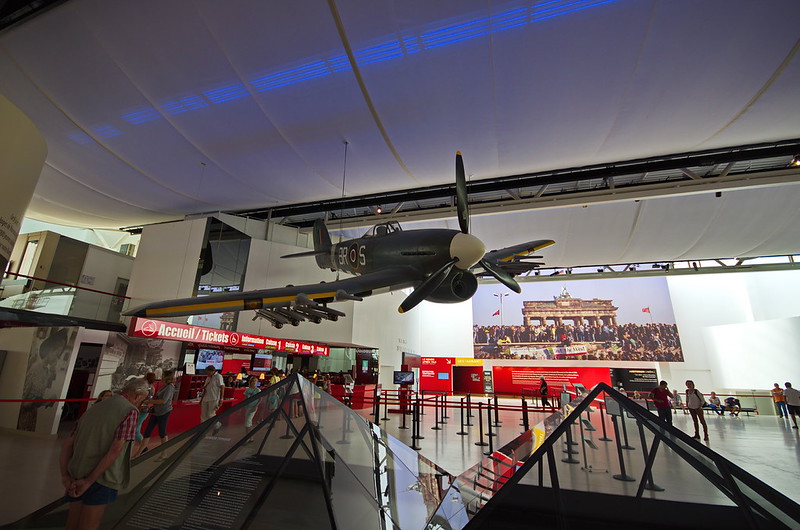
Caen Memorial Museum

Caen Memorial Museum — Key Facts for 2026

15km from the Ouistreham ferry port · In Caen itself · Adult ticket €20.80 · Free parking on site · Average visit 4 hours · Open 7 days a week (closed 3 weeks in January)

Check Ferry Prices & Book Portsmouth to Caen →

🏛️ Caen Memorial Museum at a Glance

1988
Inaugurated by President François Mitterrand
€20.80
Full adult admission in 2026, with several reduced rates available
4 hrs
The museum’s own recommended average visit length
FREE
On-site parking, just a few minutes’ walk from the entrance
  • One of Europe’s leading WWII & Cold War museums — over 14,000 square feet of exhibition space covering 1918 to the fall of the Berlin Wall
  • Built around a real German command bunker — General Richter’s underground bunker, used during the actual Battle for Caen, is part of the museum itself
  • A dedicated D-Day and Battle of Normandy section — the ideal primer before visiting Sword, Juno, Gold, Omaha or Utah beaches
  • Memorial gardens — peaceful outdoor spaces dedicated to peace, reconciliation and remembrance, free to walk
  • ⚠️Closed for around three weeks every January and on selected other days — check current Caen Memorial Museum opening hours before travelling (details below)

The History of the Caen Memorial Museum

Caen itself was one of the most devastated cities of the entire Battle of Normandy — roughly 75% of it was destroyed in the fighting that followed D-Day, as Allied forces took nearly two months to fully liberate a city originally expected to fall within days. That experience of near-total destruction, and the city’s subsequent reconstruction, directly shaped the museum built here decades later.

A Museum of Peace, Not a Museum of War

The Mémorial de Caen museum was the vision of Jean-Marie Girault, the mayor of Caen, who wanted the city’s own experience of devastation to become the foundation for a museum dedicated to peace rather than a straightforward war memorial. It was inaugurated on 6 June 1988 by President François Mitterrand, on the 44th anniversary of D-Day, with representatives of the Allied nations present. The distinction between “peace museum” and “war museum” is not just marketing language — it genuinely shapes how the exhibitions are built, consistently framing conflict in terms of its human cost and the case for reconciliation rather than military triumph.

The museum stands on the Colline aux Oiseaux (“Hill of Birds”), a site chosen deliberately: directly beneath the modern building lies General Wilhelm Richter’s original underground command bunker, used by the German 716th Infantry Division during the real Battle for Caen in 1944. Rather than demolish it, the museum was built to incorporate the bunker as a genuine historical artefact — meaning part of every visit takes place inside an actual wartime structure, not a reconstruction.

🏙️ A City That Understood the Cost

Caen’s own wartime experience — weeks of Allied bombing and shelling intended to dislodge determined German defenders, followed by house-to-house fighting through the ruins — left the city more heavily damaged than almost anywhere else in Normandy. That direct, painful familiarity with what modern warfare actually costs a civilian population is precisely why Caen, rather than one of the beach towns, became home to the region’s flagship history museum.

🕊️ Expanding Beyond WWII

Since opening, the museum has grown well beyond its original Second World War focus, adding permanent galleries on the Cold War and an immersive experience tracing the broader story of 20th-century Europe. This expansion reflects the founders’ original intent: the museum was always meant to be about the pursuit of peace across the whole modern era, not a single battle or a single war.

What to See Inside the Mémorial de Caen

The Mémorial de Caen museum is organised into distinct galleries, each covering a different chapter of the 20th century — visitors typically move through them in a single, chronological route.

⚔️ Second World War Gallery

Traces the road to war from the aftermath of 1918 through the rise of Nazism in Germany, then the war itself: the French defeat of 1940, life under German occupation, the Vichy regime, collaboration and the Resistance, and the wider international conflict including the Eastern Front and the Pacific. Original artefacts, propaganda material, uniforms and archive film are used throughout, alongside deeply personal accounts from those who lived through the period. The design is often genuinely inventive — the section on Britain’s war effort, for instance, is staged inside a recreated London Underground station platform, doubling as an air-raid shelter.

🇫🇷 D-Day & the Battle of Normandy

A dedicated gallery covering the planning and deception behind Operation Overlord, the landings themselves across all five beaches, and the gruelling three-month campaign to liberate Normandy that followed — including the devastating Battle for Caen. This is the section most directly relevant to anyone planning to visit the beaches, and is widely recommended as the best possible primer before doing so.

🕳️ General Richter’s Underground Bunker

The genuine wartime command bunker the museum was built around, offering a rare, unfiltered look at how a German commander directed the defence of Caen from below ground. Walking through it is one of the most atmospheric parts of any visit — a real space rather than a reconstruction.

🌍 “Europe, Our History”

An immersive multi-screen experience placing the Second World War within the sweep of 20th-century European history — decolonisation, the growth and later fracturing of the European project, and the forces that shaped the continent before and after 1945. A useful wider-lens counterpart to the more focused WWII and D-Day galleries.

☭ The Cold War Gallery

Covers the ideological and military standoff between East and West from 1945 to 1989 — the Berlin Blockade, the nuclear arms race, the Iron Curtain and the eventual fall of the Berlin Wall — extending the museum’s story well beyond the Second World War into the decades that followed.

🌳 The Souvenir Gardens

A series of memorial gardens around the museum grounds — including gardens dedicated by Canada and the United States — offering a quiet, reflective space to walk after an intense few hours indoors. Free and open to visitors and non-visitors alike.

Amenities On Site

The museum includes Le Bistrot du Mémorial, a cafeteria serving hot and cold snacks, sandwiches and drinks (open daily, closing 30 minutes before the museum itself), and Les Pommiers, a full-service restaurant with two lunch sittings (11:30am and 1:30pm) offering a three-course menu for around €25–26 — book ahead, as it’s often used for groups. There’s also a large bookshop and gift shop — with over 5,000 titles, it’s the only bookshop in Normandy entirely specialised in 20th-century history — plus multilingual audioguides (French, English, German, Italian, Dutch and more) available as an app (+€3) or a handheld device (+€4.50). The main museum building is wheelchair accessible, though the footbridge connecting it to the outdoor Souvenir Gardens and the German bunker is less straightforward for visitors with reduced mobility.

Caen Memorial Museum Tickets & Prices for 2026

Caen Memorial Museum tickets can be bought online in advance or on arrival, though booking ahead is recommended in peak summer months and around the 6 June anniversary period.

💶 2026 Admission Rates

  • Full adult rate (19–65): €20.80
  • Child rate (10–18) & senior rate (65+): €18.50
  • Family pass (2 adults + at least 1 child 10–18, unlimited children, or 1 adult + at least 2 children 10–18): €53
  • Student (post-baccalaureate) & Caen resident rate: €6
  • Military personnel, teachers, and those accompanying a disabled visitor: €18.50
  • Free entry: children under 10 (with a paying adult), disabled visitors, veterans, jobseekers, journalists, and several other specific categories — check the official site for the full list
  • Audioguide: +€3 (smartphone app) or +€4.50 (handheld device), available in 7 languages
  • Combined ticket with the Arromanches 360° Circular Cinema: €24

Museum-Led D-Day Beach Tours

The Mémorial de Caen also runs its own guided minivan tours of the D-Day beaches, departing directly from the museum — a genuinely convenient option if you’d rather not self-drive. Tours typically run a minimum of 3 hours 45 minutes and can be combined with a museum visit on the same day or split across two days. Check the “Guided tours” section of memorial-caen.com for current itineraries and prices.

Caen Memorial Museum Opening Hours for 2026

Caen Memorial Museum opening hours vary through the year — always worth double-checking close to your visit, since the museum can adjust hours at short notice for exceptional circumstances.

🕐 Seasonal Hours

  • 1 April – 30 September: 9am – 7pm daily
  • 1 October – 16 October: 9:30am – 6pm
  • 17 October – 31 October: 9:30am – 7pm
  • 1 November – 31 December: 9:30am – 6pm
  • 2 January – 4 January & late January – 31 March: 9am – 6pm
  • On-site ticket sales close 1 hour 15 minutes before closing time. Allow the full 4 hours the museum itself recommends for a proper visit.

📅 Annual Closures

The museum closes for approximately three weeks every January (typically early-to-mid January, reopening in the final week of the month) for annual maintenance — this is the single most important date to check if you’re planning a winter visit. It’s also closed on 25 December and 1 January, and on Wednesdays throughout November and December (with exceptions made for 11 November, and 23 and 30 December). Outside these dates, the museum is open every day of the week, year-round.

Getting to the Caen Memorial Museum & Parking

The museum sits on the northern edge of Caen, on the Colline aux Oiseaux — close enough to the city centre for a short taxi or bus ride, but not within easy walking distance for most visitors.

🚗 By Car & Caen Memorial Museum Parking

From the Ouistreham ferry port, follow the D515 south toward Caen, then join the ring road (périphérique) and take exit 7 — approximately 15km, around 20 minutes. From Paris, take the A13 motorway; from Rennes, the A84. Parking: free on-site parking is available less than a 3-minute walk from the museum entrance. A separate free motorhome parking area is also available on Avenue du Maréchal Montgomery, accessible around the clock except between 9pm and 8:45am.

Caen’s ring road can be busy at peak times — allow extra time if travelling during the morning or evening rush.

🚌 By Public Transport

Bus: Line 2 runs from Caen city centre directly to the museum. From Caen railway station: allow 30–40 minutes in total by bus or tram plus a connecting bus, since the museum isn’t within the city centre itself. From the ferry port: there’s no direct public transport link to the museum; a taxi or transfer into Caen first is the practical option.

By air: Caen–Carpiquet Airport is around 9km from the city centre, with connections to several French cities including Lyon, Marseille and Toulouse.

Sample Visit: Planning Your Day at the Mémorial de Caen

Most visitors either give the museum a dedicated half-day on its own, or combine it with the D-Day beaches as the first stop of a longer day.

The Museum on Its Own — A Half Day (or More)

Perfect for: History-focused visitors, or anyone arriving on the morning ferry with a full day to spend in Caen before heading further afield.

  • 09:30: Arrive at the museum shortly after opening to beat the busiest hours
  • 09:45–13:00: Second World War and D-Day galleries, plus General Richter’s bunker (allow 3 hours minimum)
  • 13:00: Lunch at Le Bistrot du Mémorial or in Caen city centre
  • 14:00–15:30: Cold War gallery and “Europe, Our History” immersive experience
  • 15:30: Walk the Souvenir Gardens before leaving (free, 20–30 minutes)

Museum First, Then the Beaches

Perfect for: Visitors who want the essential context before heading to Sword Beach or Pegasus Bridge on the same trip.

  • 09:00: Caen Memorial Museum — focus on the D-Day and Battle of Normandy gallery (2–2.5 hours)
  • 11:30: Drive to Pegasus Bridge (15 minutes)
  • 12:00: Bridge, glider plinths and Café Gondrée (45 minutes)
  • 13:00: Drive to Sword Beach, Ouistreham (15 minutes) — lunch, then Le Grand Bunker and the beach itself
  • 16:00: Return to Caen (20 minutes)

Top Tips for Visiting the Caen Memorial Museum

  • Book Caen Memorial Museum tickets online in advance during peak summer and around the 6 June anniversary period, when queues at the door can be long.
  • Combining several Caen sights? The Caen City-Pass (available for 24, 48 or 72 hours) bundles reduced-rate entry to the Memorial with other Caen museums and attractions, plus discounts at partner restaurants and shops.
  • Genuinely allow 4 hours: this is a large, dense museum, and visitors consistently report needing the full time the museum itself recommends — don’t schedule it as a quick hour-long stop.
  • Visit before the beaches, not after: the D-Day and Battle of Normandy gallery gives essential context that makes a subsequent beach visit far more meaningful — most repeat visitors recommend this order over doing it the other way round.
  • Eat before you arrive or plan carefully: there are few restaurants within easy walking distance of the museum itself. The on-site Bistrot du Mémorial covers snacks and light meals, but book ahead for the full-service restaurant, or plan to eat in Caen city centre before or after your visit.
  • Double-check the January closure dates each year: the exact three-week window can shift slightly year to year — confirm on memorial-caen.com before booking travel around that period.
  • Consider the audioguide: at a modest extra cost, it adds substantial depth to what is already a text-and-artefact-heavy museum, particularly useful for visitors without strong French or a background in the period.

Caen Memorial Museum: Frequently Asked Questions

What are the Caen Memorial Museum opening hours?

The museum is generally open 9am to 7pm from 1 April to 30 September, and 9am/9:30am to 6pm the rest of the year, with slightly extended hours in late October. On-site ticket sales close 1 hour 15 minutes before closing. The museum closes for around three weeks every January for annual maintenance, plus 25 December, 1 January, and Wednesdays in November and December (with a few exceptions). Always check memorial-caen.com for the exact current schedule before travelling, since hours can be adjusted at short notice.

How much are Caen Memorial Museum tickets?

Full adult admission is €20.80 in 2026. Children aged 10–18 and seniors over 65 pay €18.50, a family pass is €53, and students or Caen residents pay €6. Several categories — including veterans, disabled visitors, jobseekers and children under 10 accompanied by an adult — are admitted free. An audioguide costs an extra €3 (app) or €4.50 (handheld device). A combined ticket with the Arromanches 360° Circular Cinema is available for €24.

Is there parking at the Caen Memorial Museum?

Yes. Free on-site parking is available less than a 3-minute walk from the museum entrance, with no need to pre-book. A separate free motorhome parking area is also available on Avenue du Maréchal Montgomery, open around the clock except between 9pm and 8:45am.

What is the Mémorial de Caen museum?

The Mémorial de Caen is a major history museum in Caen, Normandy, dedicated to the Second World War, D-Day, the Battle of Normandy and the Cold War, framed throughout as a museum of peace rather than a museum of war. Inaugurated in 1988 by President François Mitterrand, it’s built around a genuine German wartime command bunker and is widely regarded as the single best introduction to the D-Day story available in the region, with an average visit lasting around four hours.

How long should I spend at the Caen Memorial Museum?

The museum itself recommends around 4 hours for a full visit, though how long you actually need varies a lot by visitor: families travelling with young children often manage a satisfying pass-through in under an hour, while history enthusiasts frequently spend a full day. If time is limited, prioritise the Second World War and D-Day galleries plus General Richter’s bunker, which together cover the content most directly relevant to a Normandy beaches trip.

Should I visit the museum before or after the D-Day beaches?

Before, if you can arrange it. The museum’s D-Day and Battle of Normandy gallery provides context — the planning, the deception operations, the political stakes and the human cost — that most visitors say transforms a subsequent beach visit from simply seeing a landscape into genuinely understanding what happened there. It’s the most commonly recommended order among repeat visitors and tour guides alike.

Continue Planning Your Normandy D-Day Visit

🏖️

All D-Day Beaches

Complete hub covering all five D-Day landing beaches — Utah, Omaha, Gold, Juno and Sword — with distances from Caen and our interactive map

D-Day Beaches Hub →

Pegasus Bridge

The first Allied action of D-Day, just 9km from Caen — pairs naturally with a museum visit

Pegasus Bridge →

🇬🇧

Sword Beach

The closest D-Day beach to Caen, where the ferry itself arrives — 15km from the museum

Sword Beach →

🕊️

Normandy Cemeteries

The six essential war cemeteries of the D-Day coast — our complete visiting guide

Normandy Cemeteries →

Visit the Caen Memorial Museum — Travel via Portsmouth to Caen

Brittany Ferries sails year-round from Portsmouth to Caen (Ouistreham). From the ferry terminal, the Mémorial de Caen is approximately 20 minutes by car — the perfect first stop before exploring the D-Day beaches.

Check Prices & Book Portsmouth to Caen →