Mont Saint-Michel Day Trip from Caen: The Complete 2026 Visitor Guide

A Mont Saint-Michel day trip is one of the most spectacular you can make in France — a Gothic abbey rising straight out of the sea on a rocky island, ringed by the highest tides in continental Europe. It’s also, honestly, the most ambitious day trip covered on this site: Mont Saint-Michel is around 130km from Caen and roughly 140km from the Portsmouth to Caen ferry terminal at Ouistreham, meaning a Mont Saint-Michel day trip from the Caen ferry is a genuine full day out — around 1 hour 30 minutes’ drive each way — rather than a quick add-on to a beach visit.

What you get for that drive is one of the most photographed sights in the world: a Benedictine abbey founded in 708, built up over more than a thousand years on a granite outcrop that becomes a true island only during the highest “spring” tides — the water rushing back in, according to Norman legend, “at the speed of a galloping horse.” Mont Saint-Michel and its bay were among the very first sites inscribed on the UNESCO World Heritage list, in 1979, and the site still draws upwards of 2.5–3 million visitors a year, second in France only to Paris itself.

This complete guide to a Mont Saint-Michel day trip covers everything: how to get there from Caen and the ferry port, current 2026 abbey ticket prices and opening hours, what to see once you’re there, the tides that make this place so unique (and occasionally dangerous), and honest advice on whether a single day is really enough.

Last updated: July 2026 | Facts verified directly from the Centre des Monuments Nationaux (Mont Saint-Michel Abbey), the official Mont Saint-Michel tourism office and primary historical sources.
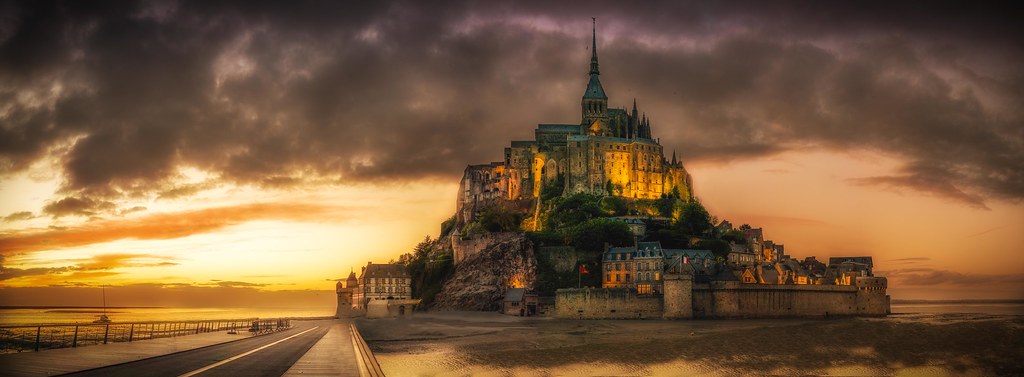
Mont Saint-Michel Day Trip

Mont Saint-Michel Day Trip — Key Facts for 2026

130km from Caen · 140km from the Ouistreham ferry port · ~1h30 drive each way · Village free, 24/7 · Abbey €16 (Apr–Sep) / €13 (Oct–Mar) · Founded 708 AD · UNESCO since 1979

Check Ferry Prices & Book Portsmouth to Caen →

🏰 Mont Saint-Michel Day Trip at a Glance

130km
From Caen — around 1 hour 30 minutes by car
FREE
The village, ramparts and bay — 24 hours a day, year-round
708 AD
Bishop Aubert founds the first chapel after a vision of the Archangel Michael
2.7M+
Visitors a year — the second most-visited site in France after Paris
  • ⚠️This is a long day out. At around 3 hours of driving round-trip from Caen alone, plus several hours on site, a Mont Saint-Michel day trip realistically needs a very early start and a late finish
  • The Abbey — the architectural and spiritual heart of the site, €16 adults (April–September) or €13 (October–March). Allow 1.5–2 hours
  • The village and ramparts — free to enter at any time, no ticket needed, with shops, restaurants and spectacular bay views
  • Free shuttle buses run from the mainland car parks to within 400m of the entrance — you can’t drive onto the Mont itself
  • ⚠️Never walk in the bay without a guide. The tides here are the fastest and highest in continental Europe, and the sand hides genuine quicksand

The History of Mont Saint-Michel

Few sites in France pack quite so many centuries of continuous, dramatic history into so small a space — Mont Saint-Michel covers barely 0.4 square kilometres, yet its story runs from Dark Age visions to Napoleonic prisons to a modern engineering project finished only a decade ago.

From a Bishop’s Vision to a Fortress Abbey

According to tradition, in 708 AD the Archangel Michael appeared three times in dreams to Aubert, Bishop of Avranches, insisting a sanctuary be built on the rocky island then known as Mont Tombe. Aubert obliged, and the site — echoing an older shrine to the Archangel on Monte Gargano in Italy — became a place of pilgrimage almost immediately. In 966, Duke Richard I of Normandy installed Benedictine monks on the Mount, and construction of the great Romanesque abbey church began in 1023, built directly on top of the rock’s summit in a remarkable feat of medieval engineering.

During the Hundred Years’ War, Mont Saint-Michel became a symbol of French resistance: its fortifications withstood an English siege from 1423 to 1434, never falling despite years of blockade — helped enormously by the treacherous bay itself, which made a full assault almost impossible. The Romanesque choir did collapse in 1421 under the strain of war, but wasn’t rebuilt in its current Flamboyant Gothic style for another century. This successful defiance is part of why the Mount became such an enduring symbol of French identity.

⛓️ The “Bastille of the Seas”

Pilgrimage declined from the 17th century, and after the French Revolution the abbey was stripped of its religious role and turned into a prison, holding political prisoners through the 19th century — earning it the grim nickname “the Bastille of the Seas.” The prison finally closed in 1863, by which point the buildings were badly dilapidated. Restoration began after the site was listed as a historic monument in 1874, and a small community of Benedictine monks returned to live and worship there in 1969.

🌊 “Saint Michael in Peril of the Sea”

For centuries, the Mount’s official name was “Saint-Michel-au-Péril-de-la-Mer” — Saint Michael in Peril of the Sea — a direct reference to the genuine danger pilgrims faced crossing the tidal bay on foot. Medieval chronicles record eighteen pilgrims drowning in a single incident in 1318, caught by the incoming tide; others were lost to the bay’s hidden pockets of quicksand. The name has since been shortened, but the danger it describes hasn’t gone away.

🌉 A Modern Engineering Fix

A permanent causeway built in 1879 made the Mount far easier to reach — but it also disrupted the tidal currents, causing the bay to silt up so badly that the island was at risk of one day becoming permanently attached to the mainland. A major restoration project replaced the old causeway with a slender bridge and a tidal dam (barrage) on the River Couesnon, completed in 2015, allowing the sea to flush the bay properly again and restoring the Mount’s island status during the highest tides.

🇬🇧 Its Cornish Twin: St Michael’s Mount

British visitors may recognise the silhouette: St Michael’s Mount, the near-identical tidal island off Marazion in Cornwall, isn’t just a coincidental lookalike. Edward the Confessor granted it to the abbey of Mont Saint-Michel in the mid-11th century, and in 1135 the Norman abbot Bernard du Bec had a dependent priory built there — effectively a miniature outpost of the Norman abbey on English soil, staffed by monks answering to Normandy. The two communities stayed closely linked for nearly three centuries, with a Cornish monk making the pilgrimage across the Channel most years, until the Hundred Years’ War made a French-controlled priory on English soil politically untenable and the connection was formally severed in 1424. One faint trace of that relationship survives in the very manuscripts on display at the Avranches Scriptorial (see below): a 900-year-old chronicle in the collection carries extra pages historians believe were added by a visiting monk from the Cornish Mount.

What to See on Your Mont Saint-Michel Day Trip

Everything at Mont Saint-Michel is contained within a small, steep, cobbled village climbing up to the abbey at the summit — expect stairs, and lots of them. If you’ve searched “how to get to Le Mont Saint Michel” or “how to reach Mont Saint Michel” and landed here, the short answer is: by car from Caen, then on foot or by shuttle once you park — full detail below.

⛪ Mont Saint-Michel Abbey

The reason most visitors make the journey. Reached via the Grand Degré, a steep stone staircase of around 350 steps, the abbey is really two structures in one: the abbey church itself at the summit, and La Merveille (“The Marvel”) — a three-storey Gothic wonder built into the north side of the rock, housing the cloisters, refectory and Knights’ Hall. The verticality is the whole point: everything had to be stacked, layered and wound around the shape of the rock itself, rising some 80 metres above the bay at its highest point and producing one of the most architecturally daring buildings of the medieval world. Look up as you climb and you’ll spot the gilded statue of the Archangel Michael crowning the spire, added during 19th-century restoration work and visible for miles across the flat bay.

Admission 2026: €16 adults (1 April–30 September), €13 adults (1 October–31 March). Free for under-18s, EU citizens aged 18–25, visitors with disabilities and one companion, and jobseekers (proof required) — a valid ticket must still be collected even for free admission. Free for everyone on the first Sunday of the month, November to March. Hours: 9am–7pm May–August, 9:30am–6pm September–April (last admission one hour before closing; last audioguide 1.5 hours before closing). Closed 1 January, 1 May and 25 December, plus occasional exceptional closures — check abbaye-mont-saint-michel.fr before travelling. Booking a timed online ticket in advance is strongly recommended in peak season. If you’d rather not deal with the official booking window at all, several third-party operators sell fast-track entry tickets that skip the general queue for a premium — a reasonable middle ground between self-booking and paying for a full guided tour.

🏘️ The Village & Ramparts

Free to enter at any time, day or night, with no ticket required — this is a genuine French commune, not a paid attraction. The Grande Rue, the single steep main street, is lined with shops, hotels and restaurants; the ramparts encircling the village offer some of the best bay views anywhere on the site, and are especially atmospheric early morning or after the day-trip coach crowds have left.

🍳 La Mère Poulard & “The World’s Most Famous Omelette”

Founded in 1888 by innkeeper Annette Poulard, this historic restaurant invented its signature soufflé omelette — whisked in copper bowls and cooked over an open wood fire — as a way to feed unpredictable numbers of tide-dependent pilgrims quickly. It’s genuinely famous (past guests reportedly include heads of state and Ernest Hemingway) but also genuinely expensive, at roughly €30–€49 for a single omelette, and visitor reviews are decidedly mixed on whether it’s worth it. Most other restaurants on the Mount now serve their own “Mont Saint-Michel omelette” at a fraction of the price, if you’d rather skip the queue and the premium.

🌾 A Guided Bay Walk

Walking out onto the bay’s sand flats, guided by a certified local guide who knows the tide tables and safe routes, is one of the most memorable ways to experience Mont Saint-Michel — seeing it rise ahead of you exactly as pilgrims once did. Trips run from a few hours to multi-day options, typically departing from Genêts or other mainland points. Never attempt this without a guide: the combination of fast tides and quicksand is genuinely dangerous, not just a tourist-brochure warning.

🌅 The Tides Themselves

The Bay of Mont Saint-Michel has the highest tidal range in continental Europe. French tide tables rate every tide with a “coefficient” between 20 and 120, a measure of how big that particular tide will be relative to the average; anything above about 100 counts as a grande marée, and it’s only at the very top of the scale — coefficients of 110 and above, with the most extreme reaching around 12.85 metres in amplitude — that the Mount briefly becomes a true island again, cut off by the sea exactly as it was before the modern bridge. At the highest “spring” tides (most dramatic around the equinoxes), the sea can retreat over 15km at low water, then race back in at speeds Norman folklore compares to a galloping horse. Check the tide coefficient for your visit dates if seeing this spectacle matters to you; the tourist office publishes a calendar of the year’s biggest tides.

📜 Avranches Scriptorial — If You Have More Time

A genuinely worthwhile detour, 30–40 minutes from the Mount: Avranches has held the abbey’s own medieval manuscript collection since monks fled during the French Revolution in 1791, and the Scriptorial museum now displays a rotating selection of these thousand-year-old illuminated pages alongside exhibits on how they were made. It’s the only museum in France dedicated entirely to manuscripts, and a rare chance to see, close up, the intellectual output of the community that built the abbey above the bay. En route from Caen, Villedieu-les-Poêles — a historic copper-working town — makes a pleasant additional stop if your schedule allows it.

Mont Saint-Michel: Where to Eat

🍽️ Where to Eat on the Mount

Every mouthful on Mont Saint-Michel costs more than the equivalent a few kilometres inland — it’s a small island with a captive audience, and prices reflect that. Roughly speaking:

  • Crêperies and cafés: a savoury galette or crêpe runs roughly €8–12, making these the best-value option for a quick lunch between the abbey and the ramparts.
  • Sit-down bistros: expect somewhere in the region of €25–40 a head for a proper two- or three-course meal with a glass of something.
  • La Mère Poulard and similar: as covered above, the famous omelette experience sits well above either of these brackets — this is the “special occasion” tier, not a casual lunch stop.

A rough rule of thumb: restaurants with oversized picture menus in five or six languages tend to be pitched squarely at coach groups, and price accordingly. A shorter, French-only menu further up the Grande Rue is usually a better sign.

Eating on a Budget

Packing a picnic and eating it at the car park’s tables before or after your visit is the simplest way to sidestep island prices altogether. If you’d rather sit down properly without the premium, break your drive at Pontorson or Avranches on the way back to Caen — both have ordinary French cafés and bistros charging noticeably less than anything on the Mount itself, and Avranches doubles up nicely with the Scriptorial visit mentioned above.

How to Get to Mont Saint-Michel from Caen

Getting to Mont Saint-Michel from the Caen ferry is straightforward by car, but genuinely difficult by public transport — plan accordingly.

🚗 By Car — The Only Realistic Option

From Caen: take the N175 south-west toward Rennes as far as Pontaubault, then the D43, D75 or D275 toward Mont Saint-Michel — approximately 130km, around 1 hour 30 minutes, mostly dual carriageway and toll-free.

From the ferry port at Ouistreham: continue past Caen on the same route — approximately 140km, around 1 hour 40 minutes.

Parking: you cannot drive onto the Mount itself. Large mainland car parks sit around 2.5km away, with paid parking during the day running roughly €10–28 depending on season and vehicle size (the first 30 minutes are free, and booking online usually saves a couple of euros); parking is typically free after around 6:30pm in low/mid-season. The free shuttle bus takes about 12 minutes to reach the drop-off point 400m from the entrance and runs frequently throughout the day; walking the full distance is also an option in good weather, taking 30–45 minutes.

🚂 Without a Car — Long and Awkward

There is no direct train to Mont Saint-Michel. The realistic public transport route from Caen involves a TER train to Pontorson (the nearest station), then a connecting shuttle bus to the Mount — a combined journey of around 2.5 to 4 hours each way depending on connections, making a public-transport day trip extremely tight and, frankly, not recommended given the site deserves several hours once you arrive.

Guided coach tours departing from Caen or Bayeux are, for most visitors without a car, genuinely the most practical way to fit Mont Saint-Michel into a single day — transport, timing and parking are all handled for you.

Is a Day Trip Really Enough?

Honestly — it’s tight, but doable. A day trip gives you enough time for the abbey, a walk around the village and ramparts, and lunch, provided you leave early and accept a late return. If you want to see the Mount at dawn or after the day-trippers leave (widely considered the best way to experience it), or fancy a guided bay walk, consider an overnight stay either on the Mount itself or in nearby Pontorson, Avranches or Saint-Malo, and treat the rest of your Normandy time as a separate trip.

Mont Saint-Michel: Parking

Beyond the abbey ticket itself, another thing can catch first-time visitors out: the mainland car parks (you cannot drive onto the Mount). Here’s what to actually budget for.

🅿️ Parking at the Mainland Car Parks

Private vehicles stop around 2.5km short of the Mount, at a set of large official car parks on the mainland. From there it’s either the free shuttle bus, nicknamed “Le Passeur,” which takes around 12 minutes and runs continuously through the day, or the flat pedestrian causeway on foot, roughly 30 minutes each way and a genuinely scenic option in good weather. Whichever you choose, the fee is charged once, per vehicle, and covers the full day regardless of how long you actually stay — so a two-hour visit costs the same as a full day.

Rates shift with the season and are broadly higher in summer:

Period Car (full day) Free from
April–October around €9–10 7pm
Peak (July–August) around €15–16 7pm
November–March around €7 6:30pm

Motorcycles and campervans are priced separately from cars. Pay on exit by card or cash at the barrier machines. These figures move year to year, so treat them as a guide rather than gospel and check the current signage on arrival.

Parking Tips Worth Knowing

  • Time it for free parking: arriving after 6:30–7pm (depending on season) means no parking charge at all — the village and ramparts stay open regardless, and the Mount lit up after dark is arguably more atmospheric than by day.
  • Note your row: the car parks are large and the layout can be disorientating on the walk back — a quick photo of your zone marker saves a frustrating search later.
  • It’s per vehicle, not per person: travelling as a group of four in one car costs the same as travelling alone, so carpooling from Caen is worth arranging if you can.
  • Don’t plan to sleep in the car: overnight stays in vehicles aren’t permitted at the car parks — if you’re staying over, you’ll need a hotel in Pontorson, Avranches or Beauvoir instead.

Bonus: Mont Saint-Michel Is Also Where the GR34 Begins

One thing most Mont Saint-Michel day-trippers never realise: the abbey also marks the official starting point of the GR34, the Sentier des Douaniers (“customs officers’ path”) — France’s longest waymarked coastal trail, and the route voted the nation’s favourite long-distance walk in a 2018 FFRandonnée poll. It runs for over 2,000km from here all the way around the Breton coast to Saint-Nazaire.

A Short Taster, If You Have the Time

The trail’s official start sits right beside the abbey: cross the Couesnon river via the pont-écluse (the footbridge and lock gate just outside the site) and you’re on the GR34, heading out along the flat polder dykes that ring the bay. If your day allows an extra half hour or so, it’s a genuinely pleasant, easy, flat walk with the Mount shrinking behind you — just retrace your steps back to the car park or abbey whenever you’re ready. Note this is honestly one of the trail’s quieter, less dramatic sections; the standout GR34 scenery (Pointe du Grouin, Cancale, Saint-Malo) lies much further along and needs its own multi-day trip based in Brittany, not a Caen day trip.

One important safety note: the GR34 path itself, on the dykes, is ordinary safe walking. The danger is leaving that path to walk out onto the open sand of the bay, which — as covered above — contains genuine quicksand and is subject to Europe’s fastest tides. Stay on the marked trail and there’s nothing to worry about.

If Mont Saint-Michel and the GR34 Are Your Main Reason for Coming to France

Worth being upfront about: if the abbey and the GR34 coastal path are genuinely the whole point of your trip — rather than one stop among several Normandy destinations — Portsmouth to Caen may not be the most efficient route in. Brittany Ferries also sails from Portsmouth to Saint-Malo, the same UK departure port, but landing considerably closer to both Mont Saint-Michel and the start of the GR34’s most celebrated early stages around Cancale and the Pointe du Grouin. If that sounds like your trip, it’s worth comparing both routes before you book — see www.portsmouthtostmalo.co.uk for the Saint-Malo option. For everyone else combining Mont Saint-Michel with the D-Day beaches, Bayeux, Rouen or the rest of Normandy, Caen remains the better base, and everything above still applies.

Sample Mont Saint-Michel Day Trip Itinerary

Given the distance, this only really works as a dedicated day — don’t try to combine it with much else.

The Full Day — Abbey, Village & Bay Views

Perfect for: Making the most of the long drive with a properly full day on site.

  • 07:00: Depart Caen early (1.5 hours’ drive)
  • 08:30: Park and take the free shuttle to the Mount, arriving before the biggest coach crowds
  • 09:00: Abbey visit (1.5–2 hours, book a timed ticket in advance)
  • 11:00: Walk the ramparts and explore the village
  • 12:30: Lunch on the Mount (or bring a picnic for the mainland car park area)
  • 14:00: Free time — shops, photography from the causeway, or a rest before the drive back
  • 15:30: Return to Caen (1.5 hours, arriving around 17:00)

Top Tips for Your Mont Saint-Michel Day Trip

  • Book abbey tickets online in advance: timed tickets help you skip the worst queues, especially in July and August, and are normally released around a month ahead.
  • Wear proper walking shoes: steep cobbled streets, roughly 350 steps up to the abbey, and uneven ramparts make this a genuinely physical visit — there are no lifts inside the abbey itself. That said, it’s more manageable than it sounds for visitors with limited mobility: accessible shuttle buses and restrooms are available, and wheelchairs can be borrowed free of charge from the Tourist Information Centre on the mainland.
  • Start as early as you can: Mont Saint-Michel is at its most magical — and least crowded — first thing in the morning or in the last hour before closing, once the big coach tours have moved on.
  • Check the tide calendar if the tides themselves are the draw: the most dramatic “galloping tide” effect only really happens around the highest spring tides, usually near the equinoxes — an ordinary day’s tide is far less visually dramatic.
  • Skip La Mère Poulard’s omelette unless you specifically want the experience: it’s a genuine slice of 19th-century history, but reviews are decidedly mixed for the price. Plenty of other restaurants on the Mount serve a much cheaper version of the same dish.
  • Never walk on the sand without a certified guide: the bay’s tides and quicksand have caused real fatalities historically and still catch out unprepared visitors — this is genuine safety advice, not a tourist-brochure exaggeration.

Mont Saint-Michel Day Trip: Frequently Asked Questions

Where is Le Mont Saint-Michel?

Le Mont Saint-Michel sits on a small rocky island in a large tidal bay on the border between Normandy and Brittany, in the Manche department of France. It’s approximately 130km from Caen, 140km from the Portsmouth to Caen ferry terminal at Ouistreham, and around 360km west of Paris. The nearest towns are Pontorson (Normandy side) and Saint-Malo and Avranches, both within easy reach.

How do you get to Le Mont Saint-Michel?

By far the easiest way is by car, following signs toward Mont Saint-Michel from the N175 (from Caen) or the N176/D976 (from Saint-Malo). You’ll park in one of the large mainland car parks around 2.5km from the site, then reach the Mount itself by free shuttle bus, on foot, or by horse-drawn carriage. There’s no direct train — the nearest station is Pontorson, connected to the Mount by shuttle bus — so most visitors without a car use a guided coach tour instead.

How do you go to Mont Saint-Michel from the Caen ferry?

From the Portsmouth to Caen ferry terminal at Ouistreham, drive south to join the N175 towards Rennes, following it as far as Pontaubault before picking up the D43, D75 or D275 signposted for Mont Saint-Michel — a journey of around 140km, roughly 1 hour 40 minutes. There’s no practical public transport option directly from the ferry port, so a hire car, your own vehicle, or a pre-booked coach tour are the realistic choices for a Mont Saint-Michel day trip from the Caen ferry.

How do you reach Mont Saint-Michel once you’ve parked?

You cannot drive directly onto Mont Saint-Michel itself. From the mainland car parks, around 2.5km away, you have three options: a free shuttle bus (“Le Passeur”), which runs frequently and drops you around 400m from the entrance; walking the causeway on foot, which takes roughly 30–45 minutes and offers superb photo opportunities; or a paid horse-drawn carriage. Most visitors use the free shuttle in one direction and walk in the other.

How much does it cost to visit Mont Saint-Michel?

The island and village are entirely free to enter, at any time. The abbey — the main paid attraction — costs €16 for adults from April to September, or €13 from October to March, with free entry for under-18s, EU citizens aged 18–25, and several other categories. Add parking (a few euros, often free after early evening) and food, and a full day including the abbey typically costs somewhere in the region of €40–€80 per person, excluding transport.

Why are the tides at Mont Saint-Michel so famous?

The Bay of Mont Saint-Michel has the largest tidal range in continental Europe — the sea can retreat more than 15km at low tide and return at remarkable speed, historically described in Norman folklore as coming in “like a galloping horse.” At the highest spring tides, usually around the equinoxes, the incoming water briefly cuts the Mount off completely, turning it back into a true island. The combination of speed and the bay’s hidden quicksand has caused real historical tragedies, which is why walking the sands without a certified guide is strongly discouraged.

Can you walk the GR34 from Mont Saint-Michel?

Yes — Mont Saint-Michel is the official starting point of the GR34, France’s longest waymarked coastal trail, voted the nation’s favourite long-distance walk in 2018. The path crosses the Couesnon river footbridge beside the abbey and heads out along the bay’s polder dykes. A short there-and-back taster works well alongside a day trip; walking further towards Cancale and Saint-Malo needs an overnight stay in Brittany rather than a Caen day trip.

Continue Planning Your Normandy Visit

🏰

Bayeux Day Trip

A much shorter day trip with its own medieval charm, the Bayeux Tapestry story and D-Day history

Bayeux Guide →

🏖️

All D-Day Beaches

Complete hub covering all five D-Day landing beaches — Utah, Omaha, Gold, Juno and Sword — with distances from Caen and our interactive map

D-Day Beaches Hub →

🏛️

Mémorial de Caen

The world’s finest D-Day museum, right in Caen itself — an easy addition if you’re not making the long trip to Mont Saint-Michel

Mémorial de Caen →

🗺️

All Day Trips from Caen

Honfleur, Rouen, Giverny and more — the complete guide to exploring beyond the beaches

Day Trips Hub →

Plan Your Mont Saint-Michel Day Trip — Travel via Portsmouth to Caen

Brittany Ferries sails year-round from Portsmouth to Caen (Ouistreham). From the ferry terminal, Mont Saint-Michel is around 1 hour 40 minutes by car — a long drive, but one of the most unforgettable sights in France waits at the other end.

Check Prices & Book Portsmouth to Caen →