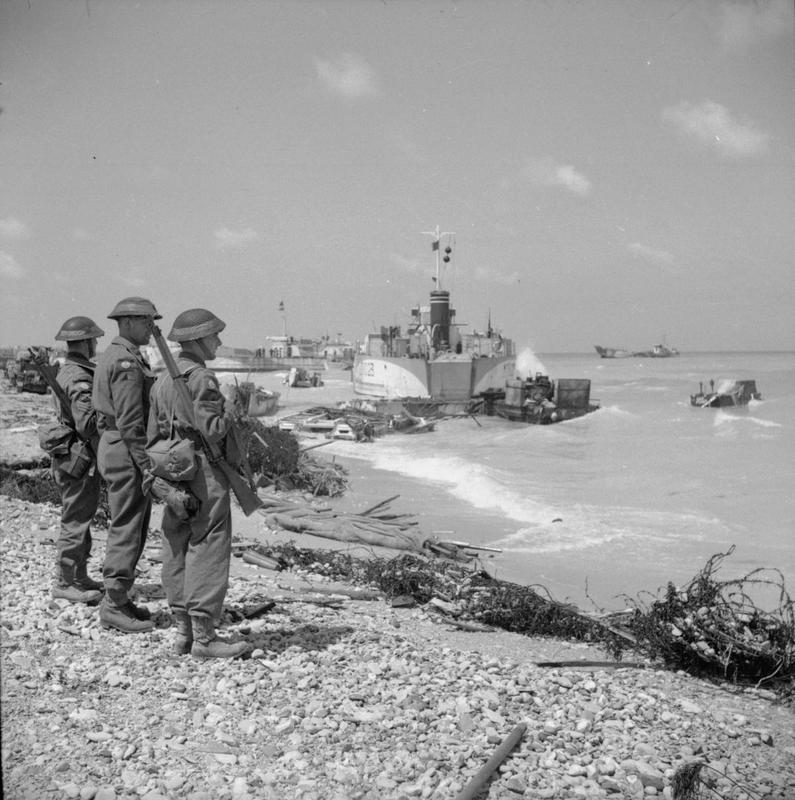
Sword Beach is the easternmost of the five D-Day landing beaches in Normandy, France — and the one with the most direct connection to the Portsmouth to Caen ferry. The Brittany Ferries terminal at Ouistreham sits at the eastern end of Sword Beach itself: when you step off the ship, you are standing where, at 07:25 on the morning of 6 June 1944, the British 3rd Infantry Division waded ashore under fire. The beach you pass as you drive out of the port gate is Sword Beach. No other ferry route from the UK puts you so immediately and literally in the landscape of D-Day.
Sword Beach, Normandy stretched approximately 8 kilometres along the Calvados coast — part of the Côte de Nacre (Mother-of-Pearl Coast) — from Saint-Aubin-sur-Mer in the west to Ouistreham in the east. As part of Operation Neptune (the naval assault phase of Operation Overlord), it was assaulted by the British 3rd Infantry Division alongside Free French commandos, Royal Marine commandos, and the 1st Special Service Brigade under Lord Lovat, with the objective of breaking through the German coastal defences, driving 15 kilometres inland to capture Caen, and linking up with British paratroopers who had seized the bridges over the Caen Canal and the River Orne in the hours before dawn. By the end of D-Day, approximately 29,000 men had landed on Sword Beach at a cost of around 630 casualties. Caen was not captured that day — it would not fall until July — but a deep beachhead had been established and the bridges held.
This complete Sword Beach guide covers everything you need to plan your visit in 2026: the full story of what happened on D-Day at Sword Beach, who landed and with which regiments, the casualty figures and what they mean, every significant memorial and museum you can visit today — from Le Grand Bunker in Ouistreham to the Bill Millin statue at Colleville-Montgomery — practical guidance on getting there from Caen, and a sample day combining Sword Beach with Pegasus Bridge and the Mémorial de Caen.
Last updated: June 2026 | Historical facts verified from Imperial War Museum, CWGC, Britannica and primary sources. Visiting details verified 2026.