Honfleur Day Trip: The Complete 2026 Visitor Guide

A Honfleur day trip is one of the most rewarding you can make in Normandy France — a perfectly preserved harbour town on the south bank of the Seine estuary, credited as the birthplace of Impressionism, and one of the few places on the Normandy coast to escape both wartime destruction and modern overdevelopment. Honfleur is around 64km from Caen and roughly 74km from the Portsmouth to Caen ferry terminal at Ouistreham — an easy 50-minute drive that makes it one of the simplest and most beautiful half-day or full-day trips on this entire site.

Honfleur Normandy France earned its reputation the hard way: overshadowed as a working port by its bigger neighbour Le Havre from the 18th century onward, the town’s maritime decline turned out to be an accidental blessing — its slate-fronted harbour houses and cobbled lanes survived untouched, and by the 19th century that same light and atmosphere had drawn a young Claude Monet, taught to paint outdoors by local artist Eugène Boudin, in a meeting now regarded as one of the founding moments of Impressionism.

This complete guide to a Honfleur day trip covers everything: the town’s remarkable art history, the best things to do in Honfleur (or Honfleur things to do, however you’re searching for it), where to eat, how to get there from Caen (and why that’s a far better option than the longer hauls from Calais or the soon-to-close Le Havre ferry route), and a sample itinerary to help you make the most of a single day.

Last updated: July 2026 | Facts verified from Normandy Tourism, the Musées de Honfleur and primary historical sources.
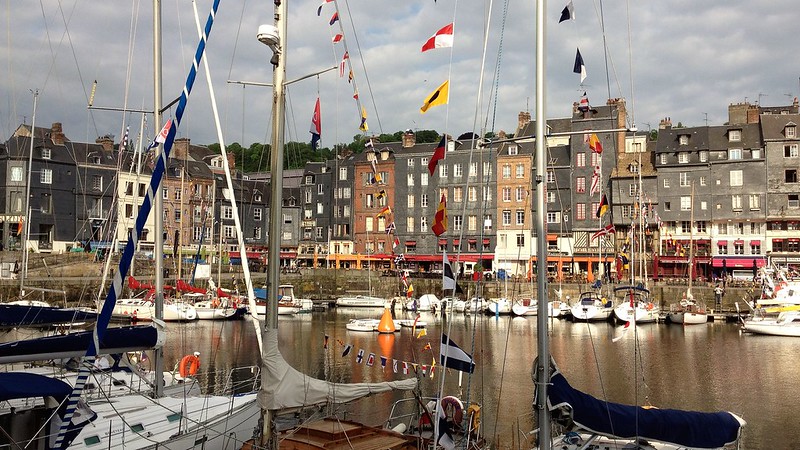
Honfleur Day Trip, Honfleur Harbour

Honfleur Day Trip — Key Facts for 2026

64km from Caen · 74km from the Ouistreham ferry port · ~50 minutes by car · Birthplace of Impressionism · Old town free to explore · 5+ million visitors a year

Check Ferry Prices & Book Portsmouth to Caen →

⛵ Honfleur Day Trip at a Glance

64km
From Caen — around 50 minutes by car
FREE
The old harbour, streets and church — no ticket needed to explore the town itself
1824
Birth year of Eugène Boudin, the “father of Impressionism”
2,141m
Length of the Pont de Normandie, linking Honfleur to Le Havre
  • Vieux Bassin (Old Harbour) — Honfleur’s postcard heart, tall slate-fronted houses reflected in still water. Free, always open
  • Église Sainte-Catherine — the largest all-wooden church in France, built by shipwrights in the 15th century. Free entry
  • Musée Eugène Boudin — the essential stop for understanding Honfleur’s role in the birth of Impressionism. Around €8 adults
  • An excellent food scene — Norman seafood, cider and calvados, from Michelin-recognised fine dining to harbourside bistros
  • ⚠️Much closer via Caen than via Calais or Le Havre. See the “Getting There” section below — this genuinely changes which ferry route makes sense for a Honfleur-focused trip

The History of Honfleur: Birthplace of Impressionism

Honfleur’s name appears in documents as far back as the 11th century, when it was already a significant port of the Duchy of Normandy — a strategic double role that defined the town for centuries: defending the mouth of the Seine, and launching the great maritime adventures that followed.

A Decline That Saved the Town

In 1608, the explorer Samuel de Champlain set sail from Honfleur on the voyage that founded Quebec City — one of several expeditions to what became New France launched from this harbour. But by the 18th and 19th centuries, Honfleur’s fortunes were fading: its harbour entrance silted up, and a direct rail line built from Paris to Le Havre in 1847 cemented that larger port’s dominance. Honfleur got its own branch railway in 1867, but it too was eventually discontinued, leaving the town a quiet backwater. That commercial decline is precisely why Honfleur looks the way it does today — spared the industrial redevelopment that transformed its rival, its historic harbour and timber-framed streets survived almost entirely intact.

Remarkably, Honfleur also escaped serious damage in both World Wars, despite sitting close to the front lines during the Battle of Normandy in 1944 — one of the few larger towns on this stretch of coast that can say the same.

🎨 The Boudin-Monet Meeting

Eugène Boudin, born in Honfleur in 1824 to a sailor’s family, became fascinated by the changing light on the water and coastline around the town — earning him the nickname “king of the skies” from the poet Baudelaire. In the 1850s, Boudin befriended an 18-year-old caricaturist named Claude Monet and persuaded him to try painting outdoors instead. Monet later credited Boudin with opening his eyes to landscape painting entirely, and brought friends including Renoir and Pissarro to see Honfleur for themselves. Historians regard this meeting as one of the direct sparks of Impressionism.

🏡 The Ferme Saint-Siméon

On the hills above town, a modest inn run by a landlady known as “Mère Toutain” became the informal gathering point for Boudin, Monet, Courbet, Corot and Sisley — eating, drinking and painting together without her ever charging them rent. Later nicknamed “the inn of the Impressionists,” the Ferme Saint-Siméon is now a luxury Relais & Châteaux hotel; you can even book the room where Monet himself once stayed.

🎵 Erik Satie’s Hometown

Composer Erik Satie, one of music’s great eccentrics and a forerunner of minimalism and ambient music, was born in Honfleur in 1866. His half-timbered childhood home is now the Maisons Satie museum, a deliberately surreal, audio-guided experience that plays his music according to which room you’re standing in — a fitting tribute to a composer who titled one piece “Three Pieces in the Shape of a Pear.”

Things to Do in Honfleur

Honfleur is genuinely compact — most of what to see in Honfleur France is within a five-minute walk of the old harbour, which makes it one of the easiest towns in Normandy to explore properly in a single day.

⛵ Vieux Bassin — The Old Harbour

The Vieux Bassin is Honfleur’s centrepiece: tall, narrow, slate-fronted houses along the Quai Sainte-Catherine, reflected in the still harbour water alongside bobbing yachts and old fishing boats — very likely the exact view you’ve already seen in a painting somewhere without knowing it. It’s at its best early morning or around sunset, when the crowds thin and the light does what first drew Boudin here. At the harbour mouth stands La Lieutenance, the 16th–17th century former residence of the King’s Lieutenant, now a heritage interpretation centre with panoramic views from its terraces. Free, always accessible, and — along with Honfleur’s cobbled streets themselves — the single best reason to visit.

⛪ Église Sainte-Catherine

France’s largest all-timber church, built by local shipwrights in the late 15th and early 16th centuries using boat-building techniques — walk inside and the vaulted roof genuinely resembles an upturned hull. Its bell tower stands entirely separate from the main building, a deliberate precaution against fire. Free entry, and worth returning to more than once as the light through the windows changes through the day.

🖼️ Musée Eugène Boudin

Founded in 1868 by Boudin himself and fellow artist Alexandre Dubourg, this is one of the finest small art museums in Normandy — one of the world’s best collections of Boudin’s own work, plus paintings by Monet, Courbet, Jongkind and Dufy. Admission: around €8 adults, English audioguide available. Allow 1–1.5 hours. Located on Place Erik Satie; closed on certain winter days, so check ahead. If you’re planning to see more than one museum, the Musées de Honfleur combined pass covers this museum, the Maisons Satie, the Musée de la Marine and the Musée d’Ethnographie et d’Art Populaire Normand together at a better combined price than buying separately.

🍐 Maisons Satie

An interactive, headphone-guided walk through composer Erik Satie’s surreal childhood home, complete with a room of flying winged pears — genuinely one of the more unusual small museums in France, and a good option for visitors travelling with children or teenagers who might otherwise find a fine-art museum less engaging. Around €6–8 admission.

🧂 Greniers à Sel

Two enormous 17th-century stone warehouses, originally built to store salt used for preserving the town’s cod-fishing catch, now used as atmospheric event and exhibition spaces. Worth a look from the outside even if there’s no exhibition running when you visit.

🌳 Jardin des Personnalités

A landscaped garden along the Seine estuary walk, dotted with busts of Honfleur’s famous names — Boudin, Monet, Satie, Baudelaire and Samuel de Champlain among them. Ten hectares of walkways, ponds and roses, particularly lovely in early summer. Free, open access.

🦋 Naturospace

An unexpected but popular detour: a tropical greenhouse in the north of town, home to hundreds of free-flying butterflies from around the world — a good option with children, or simply as a warm, humid contrast to a breezy Norman afternoon.

⛲ Chapelle Notre-Dame de Grâce

A short walk or drive east of the old town, this 17th-century chapel sits on a hilltop with genuinely superb panoramic views over the Seine estuary, Le Havre and the Pont de Normandie, its interior filled with votive model ships left by sailors’ families over the centuries. Around Pentecost each year, the chapel hosts the Fête des Marins (Sailors’ Day), when local children dressed as sailors climb the hill to present small model ships as offerings — a genuinely local tradition most visitors never see. Free, open access.

Markets & the Pont de Normandie

If your visit falls on the right day, Honfleur’s markets are genuinely worth timing around: a traditional market fills Place Sainte-Catherine every Saturday morning, an organic market takes over the same square on Wednesdays, and a fish market runs Thursday to Sunday mornings by the harbour. For a different perspective on the town, several local operators run boat trips from the harbour: a 45-minute guided tour around the basins themselves, or a longer 1.5-hour cruise out along the Seine estuary and back beneath the Pont de Normandie. On your way in or out, the bridge itself — a 2,141-metre cable-stayed structure linking Honfleur to Le Havre, the longest of its kind in the world when it opened in 1995 — is a spectacular piece of engineering in its own right, with a pedestrian and cycle path across it for those who want a closer look.

Best Restaurants in Honfleur

Honfleur takes its food seriously, with the day’s fishing landed a short walk from most of the harbourside restaurants — oysters, scallops and mussels feature everywhere, usually alongside Norman cider or calvados.

⭐ Fine Dining

SaQuaNa — a modern, industrial-chic fine-dining room that has held Michelin recognition in recent years, built around fresh, simply presented seafood. Le Bréard — a small, quietly avant-garde restaurant tucked down an alley off Rue Brûlée, similarly well-regarded. Les Impressionnistes, the gastronomic restaurant at the Ferme Saint-Siméon, offers a multi-course tasting menu with sweeping estuary views from the heights above town — reserve ahead, prices start from around €40 per person.

🦪 Harbourside Seafood

Le Bistro du Port and La Lieutenance both sit directly on the Vieux Bassin with reliably good seafood platters and harbour views — arrive early or book ahead, as both fill quickly. Côté Resto, just off Place Sainte-Catherine, is a solid all-rounder with a good-value menu of the day. All three are popular enough that walk-in tables can be scarce at peak lunch and dinner times in summer.

🥧 Everyday & Good Value

Au P’tit Mareyeur on Rue Haute pairs fresh seafood with produce from local farms at genuinely fair prices, particularly at lunch. Le Bistrot des Artistes, overlooking the Vieux Bassin, is a reliable spot for honest home-style Norman cooking, from skate in mustard sauce to veal chop. Both are good options if the fine-dining prices elsewhere in town are more than you fancy for a casual lunch.

Getting to Honfleur from Caen

Caen to Honfleur is a short, easy drive, and — for anyone weighing up which UK ferry route to book — genuinely one of the best reasons to choose Portsmouth to Caen over the alternatives.

🚗 By Car — 64km, ~50 Minutes

From Caen: follow the D513 along the Côte Fleurie, then cross the Pont de Normandie (toll approximately €5.90 for cars) — around 64km, 50 minutes.

From the ferry port at Ouistreham: continue past Caen on the same route — approximately 74km, around 1 hour. Central parking is paid rather than free — the main Parking Bassin du Centre on Quai de la Tour costs around €7 for two hours — with cheaper or free options further from the harbour if you don’t mind a short walk. Honfleur’s harbourside streets are largely pedestrianised in summer.

🚌 By Public Transport

A Nomad Car bus service connects Caen to Honfleur directly, taking around 57 minutes, though only every few hours — check nomad-normandie.fr for current timetables. Given the modest journey time and the ease of parking on arrival, most visitors find driving considerably more convenient.

Why Do Calais to Honfleur When Caen Is So Much Closer?

If Honfleur is a genuine priority for your trip rather than a brief afterthought, it’s worth looking hard at where you actually cross the Channel. Driving from Calais to Honfleur is around 275km and takes roughly 3 hours after you’ve already crossed via Eurotunnel or a Dover–Calais ferry — a long haul before your holiday has properly begun, and a route built around getting to Paris or northern France quickly, not Normandy. Sailing Portsmouth to Caen instead puts you within 64km and under an hour of Honfleur from the moment you drive off the ship, with a considerably more relaxed overnight or daytime crossing rather than a short, functional Channel hop followed by hours of French motorway. For a trip genuinely built around Honfleur and the Normandy coast, Caen is simply the more sensible port to sail into.

Portsmouth to Le Havre Is Closing — Here’s the Alternative

If you’ve previously sailed Portsmouth to Le Havre specifically to reach Honfleur — a sensible choice in the past, since the Le Havre to Honfleur drive is just a few minutes across the Pont de Normandie — it’s worth knowing that Brittany Ferries has confirmed this route will close by October 2026, citing sustained low passenger numbers and rising costs. The good news is that Portsmouth to Caen is a very natural replacement: Honfleur is only marginally further from Caen (64km) than it was from Le Havre across the bridge, the Caen route runs far more frequently, and you gain easy access to the D-Day beaches, Bayeux and the rest of Normandy in the same trip. If Le Havre was your route of choice, this is the moment to switch your booking to Portsmouth to Caen.

Sample Honfleur Day Trip Itinerary

Honfleur rewards an unhurried pace — this itinerary leaves plenty of room to simply wander.

A Full Day in Honfleur

Perfect for: A relaxed, art-and-atmosphere-focused day, whether combined with the ferry or a wider Normandy trip.

  • 09:30: Arrive and park (50 minutes from Caen); coffee and croissant overlooking the Vieux Bassin
  • 10:00: Église Sainte-Catherine and a wander through the old streets (free, 45 minutes)
  • 11:00: Musée Eugène Boudin (around €8, 1–1.5 hours)
  • 12:30: Lunch at a harbourside restaurant (book ahead in summer)
  • 14:00: Maisons Satie, or the Jardin des Personnalités if travelling with children who might prefer the outdoors
  • 15:30: Browse the galleries and shops on Rue Cachin and Rue Haute
  • 16:30: Return to Caen (50 minutes), or continue on to Étretat (1 hour further along the coast)

Top Tips for Your Honfleur Day Trip

  • Arrive early or come late afternoon: Honfleur is genuinely one of Normandy’s most visited towns, and the Vieux Bassin gets busy with coach parties by mid-morning in peak season — the light is better early or late anyway.
  • Book restaurant tables in advance for summer weekends: the best-known harbourside spots and the fine-dining rooms fill up quickly; walking in without a reservation on a Saturday evening in July or August is a gamble.
  • Time your visit around the markets if you can: Saturday’s traditional market and the Thursday–Sunday fish market both add genuine local colour that the main tourist streets don’t always capture.
  • Check the Boudin museum’s winter hours: it closes on certain days out of season — confirm before making it the centrepiece of an off-peak visit.
  • Combine with Étretat or the Pays d’Auge: Honfleur sits almost exactly between the dramatic chalk cliffs of Étretat (an hour further along the coast) and the cider-and-calvados country of the Pays d’Auge inland, making either a natural extension if you have more than a single day.
  • Reconsider your ferry route if Honfleur is a priority: as covered above, Portsmouth to Caen is a far shorter drive than Portsmouth to Calais, and — with Portsmouth to Le Havre closing — is now the natural alternative for reaching Honfleur by ferry at all.

Honfleur Day Trip: Frequently Asked Questions

Where is Honfleur?

Honfleur is a small port town in the Calvados department of Normandy, France, on the south bank of the Seine estuary, directly opposite Le Havre and connected to it by the Pont de Normandie. It’s approximately 64km from Caen and 74km from the Portsmouth to Caen ferry terminal at Ouistreham — around 50 minutes to an hour by car — and roughly an hour’s drive from Rouen.

What is Honfleur famous for?

Honfleur is best known as one of the birthplaces of Impressionism — local painter Eugène Boudin taught a young Claude Monet to paint outdoors here in the 1850s, drawing Courbet, Sisley and others to follow. It’s equally famous for its Vieux Bassin (old harbour), its all-timber Église Sainte-Catherine, its role in French maritime history (Samuel de Champlain sailed from here to found Quebec in 1608), and today for its restaurants, art galleries and status as one of Normandy’s most-visited towns.

What to do in Honfleur France?

The essential things to do in Honfleur are: walk the Vieux Bassin and La Lieutenance at the harbour mouth; visit the Église Sainte-Catherine, France’s largest wooden church; spend an hour or two at the Musée Eugène Boudin to understand the town’s Impressionist history; explore the surreal Maisons Satie; and browse the galleries and shops on Rue Cachin and Rue Haute. Add the Jardin des Personnalités or Naturospace if you have more time, and don’t skip a proper seafood lunch by the harbour.

What is there to see in Honfleur, France?

Beyond the postcard view of the Vieux Bassin, Honfleur has four museums (Eugène Boudin, Maisons Satie, the Musée de la Marine, and the Musée d’Ethnographie et d’Art Populaire Normand), the wooden Église Sainte-Catherine with its separate bell tower, the 16th-century Lieutenance at the harbour entrance, the 17th-century Greniers à Sel salt warehouses, and the Jardin des Personnalités gardens along the Seine estuary — all within easy walking distance of each other in a genuinely compact old town.

Is Honfleur worth visiting on a day trip?

Yes — Honfleur is compact enough to see properly in a single day, with the Vieux Bassin, main museums and a good lunch all comfortably achievable between roughly 09:30 and 17:00. If you’re a keen art lover or want to properly explore the wider Côte Fleurie, an overnight stay lets you see the harbour at dawn and dusk without the day-trip crowds, but a well-planned single day genuinely does the town justice for most visitors.

Continue Planning Your Normandy Visit

🪨

Étretat

Dramatic chalk cliffs and natural arches, an hour further along the coast — pairs perfectly with Honfleur

Étretat Guide →

🍎

Pays d’Auge & Calvados

Cider, calvados and half-timbered villages inland — a different side of Normandy close to Honfleur

Pays d’Auge Guide →

🏛️

Rouen

Joan of Arc, Monet’s cathedral and a magnificent medieval old town, an hour from Honfleur

Rouen Guide →

🏖️

All D-Day Beaches

Complete hub covering all five D-Day landing beaches, with distances from Caen and our interactive map

D-Day Beaches Hub →

Plan Your Honfleur Day Trip — Travel via Portsmouth to Caen

Brittany Ferries sails year-round from Portsmouth to Caen (Ouistreham). From the ferry terminal, Honfleur is approximately an hour by car — closer than Calais, and now the natural alternative with the Portsmouth to Le Havre route closing in October 2026.

Check Prices & Book Portsmouth to Caen →