Giverny Day Trip: The Complete 2026 Visitor Guide to Monet’s Gardens

A Giverny day trip from Caen takes you to the single most celebrated garden in France — the pink house and flower-filled grounds where Claude Monet lived, gardened and painted for 43 years, and the setting behind some of the most recognisable images in Western art. Giverny sits around 170km from Caen and roughly 180km from the Portsmouth to Caen ferry terminal at Ouistreham, making Caen to Giverny a full day out rather than a quick half-day trip, and one that pairs naturally with Rouen along the same A13 corridor.

Giverny France sits in the Eure department, right on the border between Normandy and Île-de-France, which is exactly why it works so well as a stop for both Paris-based and Normandy-based visitors. Claude Monet spotted the village from a train window in 1883, moved in within weeks, and spent the rest of his life transforming a Norman orchard into the two Monet gardens that made him famous twice over — first as a painter, then as a gardener. The Clos Normand flower garden and the water garden with its Japanese bridge remain exactly where he left them, tended today much as he tended them himself.

This complete guide to a Giverny day trip covers everything: what to expect in Monet’s garden from Caen ferry travellers’ point of view, the story behind The Artist’s Garden at Giverny and Monet’s other Giverny paintings, the American art colony the village attracted, and the practical detail that matters most — Giverny’s gardens are only open for part of the year, and there’s no need to route your visit via Paris if you’re arriving by ferry.

Last updated: July 2026 | Facts verified from the Fondation Claude Monet, the Musée des Impressionnismes Giverny, SNCF and primary historical sources.

Giverny Day Trip, Monets gardens

Giverny Day Trip — Key Facts for 2026

170km from Caen · 180km from the Ouistreham ferry port · Open 1 April–1 November 2026 only · Monet lived here 1883–1926 · 2026 marks the centenary of his death · No direct train from Caen — change at Rouen

Check Ferry Prices & Book Portsmouth to Caen →

🌸 Giverny Day Trip at a Glance

170km
From Caen — around 1 hour 50 minutes by car
43 years
Monet lived and gardened at Giverny, from 1883 until his death in 1926
€13
Adult self-guided admission to the house and gardens (2026 rate)
250+
Paintings Monet made of the water lily pond alone
  • ⚠️Giverny’s gardens are seasonal, unlike most destinations on this site. Monet’s house and gardens are only open from 1 April to 1 November each year — check dates before you build a trip around it
  • Monet’s House and Gardens (Fondation Claude Monet) — the Clos Normand flower garden and the water garden with its famous Japanese bridge. €13 adults
  • Musée des Impressionnismes Giverny — the wider story of Impressionism and the American art colony Monet attracted. Combined ticket available
  • Église Sainte-Radegonde — the small Romanesque church where Monet and his family are buried. Free, always open
  • No direct train from Caen — but you don’t need to route via Paris either. Change at Rouen instead; see our Getting There section below

Claude Monet at Giverny: 43 Years in a Painted Garden

Giverny’s transformation from a quiet farming village into one of the most visited places in Normandy happened almost by accident, sparked by a view from a train window.

From Passing Glance to Permanent Home

Claude Monet first noticed Giverny in 1883, looking out of a train window on the Vernon-to-Gasny line, and moved his large, blended household there within weeks — Monet, his two sons, his companion Alice Hoschedé and her six children all settled into a long pink house with green shutters, on a plot that was then mostly an apple orchard and kitchen garden. He rented the property at first and bought it outright in 1890, once his paintings were selling well enough to make it possible. He lived and worked there for the rest of his life, dying at Giverny on 5 December 1926 at the age of 86 — meaning 2026 marks the centenary of his death, and Giverny’s own museums have built exhibitions around the anniversary this year.

Monet treated the garden as seriously as any canvas. He researched flowering times and colour combinations meticulously, planning beds so that something would always be in bloom, and considered the garden itself one of his great works — on a par, in his own estimation, with anything he painted there. The results speak for themselves: Monet’s house and gardens are today one of Normandy’s most visited attractions, second only to Mont Saint-Michel.

🌷 The Clos Normand

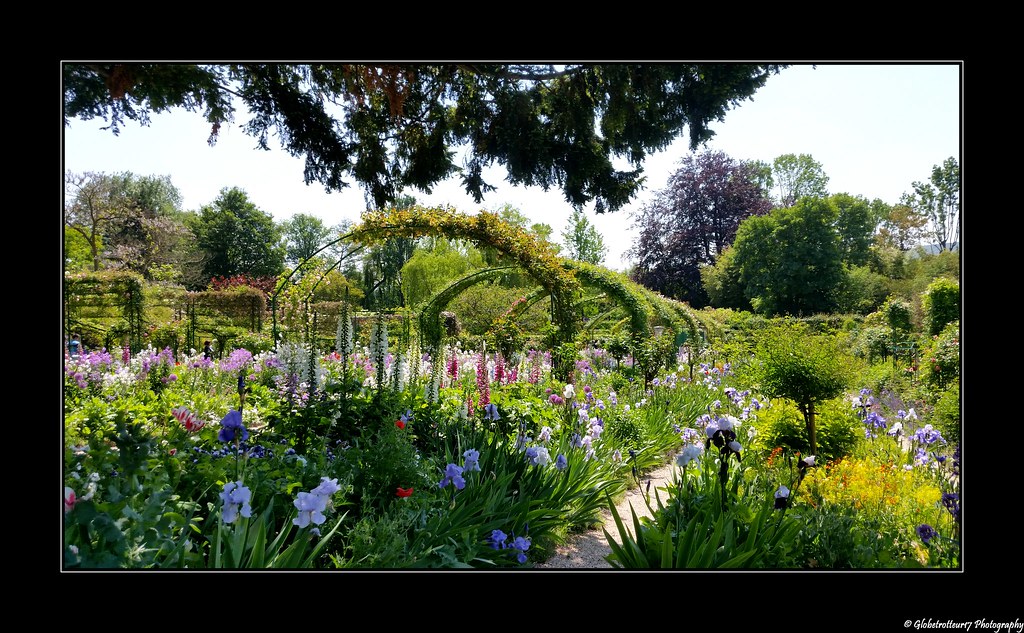
The flower garden directly in front of the house, roughly one hectare, laid out in long beds bursting with tulips, irises, roses and dahlias arranged by colour rather than in the formal, symmetrical style Monet disliked. A central path under iron rose arches runs from the gate to the house — the view most people picture when they think of Monet’s garden.

🌉 The Water Garden & Japanese Bridge

In 1893, Monet bought a neighbouring plot crossed by a small brook and, despite local objections that his “strange plants” would poison the water, had a pond dug and diverted the stream to feed it. The result — inspired by the Japanese prints he collected — became the water garden, complete with the wisteria-covered Japanese bridge and the water lilies that would occupy him for the rest of his career.

🇺🇸 The American Art Colony

From around 1887, American painters including Willard Metcalf, Theodore Robinson and Theodore Earl Butler began settling in Giverny, drawn by the landscape rather than Monet himself, whom most barely knew at first and who found their presence a mild nuisance. For roughly thirty years, up to a hundred artists passed through the village; Butler eventually married Monet’s stepdaughter, Suzanne Hoschedé. The colony faded after the First World War.

🕊️ Monet’s Death & Burial

Monet died at Giverny on 5 December 1926 and is buried, along with several family members, in a modest family tomb in the cemetery beside the village church, the Église Sainte-Radegonde — a plain grave, easy to miss, for a man whose garden changed the course of modern art.

Monet’s Garden in Art: The Artist’s Garden at Giverny

Giverny Monet paintings exist by the hundred, but one in particular carries the village’s name directly in its title — and it’s worth knowing the difference between the real garden you can visit and the painting that made it famous.

What Is “The Artist’s Garden at Giverny”?

The Artist’s Garden at Giverny (French: Le Jardin de l’artiste à Giverny) is a specific 1900 oil painting by Monet, now held in the Musée d’Orsay in Paris. It shows a close, ground-level view of the Clos Normand in high summer: diagonal rows of purple and pink irises under dappled tree shade, with a glimpse of the pink house just visible beyond the foliage. Monet was 60 when he painted it, working from the same flowerbeds visitors walk past today, and it’s one of a small cluster of closely related 1899–1900 canvases — including The Iris Garden at Giverny and The Garden in Flower — that all explore the same stretch of border from slightly different angles.

It’s a genuinely useful painting to know before you visit, because it captures something photographs of the modern garden often miss: Monet wasn’t painting a static flower bed, he was painting the effect of dappled light falling through it — the entire reason he laid the garden out the way he did in the first place.

🖼️ The Water Lilies (Nymphéas)

Separate from the Clos Normand paintings, Monet’s water garden inspired an entirely different body of work — over 250 paintings of the lily pond alone, produced across the last three decades of his life. The largest, most immersive versions, the great curved Water Lilies murals, are permanently displayed at the Musée de l’Orangerie in Paris, arranged in two oval rooms exactly as Monet intended.

📍 Where to See Monet’s Giverny Paintings Today

The Artist’s Garden at Giverny hangs in the Musée d’Orsay; the Water Lilies murals are at the Musée de l’Orangerie; and the Musée Marmottan Monet holds the largest single collection of his work anywhere, donated by his son. Closer to Normandy, the Musée des Beaux-Arts in Rouen displays Monet’s Poppy Field at Giverny — a natural stop if you’re combining both destinations on our Rouen Day Trip guide.

🎨 2026: The Monet Centenary

2026 marks 100 years since Monet’s death, and the Musée des Impressionnismes Giverny built its spring exhibition around it — “Before the Water Lilies: Monet Discovers Giverny, 1883–1890” ran from late March to early July 2026 and has now closed, with a new temporary exhibition opening in its place from mid-July. Expect further centenary-themed exhibitions across Normandy and Paris through the rest of the year.

What Else to See in Giverny

Giverny is a genuinely tiny village — around 500 residents — but there’s enough beyond Monet’s own gates to fill a comfortable full day.

🏛️ Musée des Impressionnismes Giverny

A short walk from Monet’s house, this museum covers the wider Impressionist movement and the Giverny art colony specifically, with rotating temporary exhibitions rather than a large permanent collection. It keeps a longer season than the Fondation Monet, typically open March into January. Admission: around €12 adults standalone, or a combined ticket with Monet’s house for €25.

⛪ Église Sainte-Radegonde & Monet’s Grave

A modest Romanesque church at the far end of the main street, parts of it dating to the 11th century, with Monet’s family tomb in the surrounding churchyard. Monet himself rarely attended services here, but the church and cemetery are free to visit and quiet even when the gardens are busy.

🍽️ Hôtel Baudy

The former guesthouse and unofficial headquarters of the American art colony, where painters gathered, argued and worked between excursions to paint the surrounding countryside. It’s now a café-restaurant with period décor and a small preserved artist’s studio, and still serves a full lunch menu today — a genuinely atmospheric choice for the midday break in your itinerary, not just a stop for coffee.

🚶 The Village Itself

Rue Claude Monet, the main street, is lined with small art galleries, tea rooms and houses once rented by colony painters, several marked with plaques naming who stayed there. It’s easily walkable end to end and worth slowing down for, rather than treating as a corridor between the two museums.

Getting to Giverny from Caen

Almost every “how to get to Giverny” guide online is written for people already staying in Paris. If you’re arriving via the Portsmouth to Caen ferry, the sensible route looks a bit different — and you don’t need to detour all the way into Paris and back out again to get there.

🚗 By Car — 170km, ~1h50

From Caen: take the A13 motorway east past Rouen, then continue toward Vernon — approximately 170km, around 1 hour 50 minutes. The A13 uses free-flow tolls (number-plate cameras bill you automatically, payable online within 72 hours at sanef.com, which supports UK-registered vehicles). From the ferry port at Ouistreham: continue past Caen on the same route — approximately 180km, around 1 hour 55 minutes to 2 hours.

Free parking is available in Giverny itself, in a large car park on the D5 in front of the Fondation Claude Monet.

🚂 By Train — Skip Paris, Change at Rouen

There’s no direct train from Caen to Vernon-Giverny, and Giverny itself has no station of its own. The standard “Giverny from Paris” advice you’ll find elsewhere assumes you’re starting from Paris Saint-Lazare — but if you’re travelling via the Caen ferry, there’s no need to go up into Paris at all. Trains run from Caen to Vernon-Giverny changing at Rouen Rive Droite, taking around 2 hours to 2 hours 40 minutes depending on the connection, noticeably shorter than looping via the capital.

From Vernon-Giverny station, a shuttle bus runs to the gardens (€5 single/€10 return, spring–autumn only), or it’s a scenic 5km cycle or roughly an hour’s walk along the Seine.

Book Ahead, and Check the Season First

Two things matter more here than on most of this site’s other day trips. First, Monet’s house and gardens close completely from 2 November to 31 March — there’s nothing to see behind the gates outside the April–November season, so check the dates before you commit a day to it. Second, online booking is genuinely recommended in season: without a timed ticket, queues at the entrance can run well over an hour on busy spring and summer days. Pre-booked e-tickets go in through gate Porte 1 bis on Sente Leroy, a separate, noticeably shorter queue from the main Porte 1 group entrance — worth knowing before you arrive.

Sample Giverny Day Trip Itinerary

Given the distance involved, most visitors either give Giverny a relaxed day on its own or combine it with Rouen, which sits on the same road and rail corridor.

Giverny — A Full Day

Perfect for: A relaxed, unhurried visit that treats the long drive or train ride as worth taking slowly.

  • 10:00: Arrive (around 1h50 by car from Caen); Monet’s House and Gardens (€13, allow 1.5–2 hours — go early to beat the crowds)
  • 12:00: Lunch on or near Rue Claude Monet
  • 13:15: Musée des Impressionnismes Giverny (allow 1–1.5 hours)
  • 14:45: Walk the village, Hôtel Baudy for coffee (30–45 minutes)
  • 15:30: Église Sainte-Radegonde and Monet’s grave (free, 20 minutes)
  • 16:00: Return to Caen (around 1h50 by car)

Giverny + Rouen — Combined Day

Perfect for: Making the most of a long drive by pairing Monet’s garden with Rouen’s cathedral and old town on the same A13 route.

  • 08:30: Depart Caen, drive to Giverny via the A13 (1h50)
  • 10:30: Monet’s House and Gardens (€13, allow 1.5 hours)
  • 12:15: Lunch in Giverny, quick walk down Rue Claude Monet
  • 13:30: Drive to Rouen via the A13 (around 50 minutes)
  • 14:30: Rouen Cathedral and the old town (see our Rouen Day Trip guide for the full itinerary)
  • 18:00: Return to Caen via the A13 (around 1h20)

Top Tips for Your Giverny Day Trip

  • Double-check the season before you plan around it: Monet’s house and gardens are shut completely from 2 November to 31 March. This is genuinely unusual for a Normandy attraction on this site — most of our other destinations are open year-round.
  • Book your entry ticket online in advance: especially May to September, when walk-up queues can exceed an hour. E-tickets are timed but you don’t need to print them.
  • Go early: the gardens open at 10am and get noticeably busier from mid-morning onward, particularly once coach tours from Paris start arriving.
  • If you’re travelling by train, skip the Paris routing: going via Rouen Rive Droite from Caen is faster than heading up to Paris Saint-Lazare and back out again, despite what most generic “Giverny from Paris” guides assume.
  • Bloom calendar, month by month: April brings tulips and the first wisteria on the Japanese bridge; May adds irises and rhododendrons; June is roses; July and August are peak water lily season; late summer into October brings dahlias, nasturtiums and asters. There’s no single “best” month — it depends which flowers you’re chasing.
  • Combine with Rouen if you’re driving: both sit on the same A13 corridor, and Rouen’s Musée des Beaux-Arts holds one of Monet’s own Giverny paintings, making a natural link between the two stops.

Giverny Day Trip: Frequently Asked Questions

Where is Giverny?

Giverny is a small village in France, in Europe — specifically in the Eure department, on the border between the Normandy and Île-de-France regions, on the right bank of the River Seine at its meeting point with the smaller River Epte. Giverny France sits around 75km (47 miles) northwest of Paris and around 170km from Caen, making it reachable as a day trip from either direction.

Where in France is Giverny, and what is it known for?

Giverny sits in northern France, in the Eure department of Normandy, close to the town of Vernon. It’s known almost entirely for one thing: it was the home of Impressionist painter Claude Monet from 1883 until his death in 1926, and his house and the two gardens he designed there — the Clos Normand and the water garden with its Japanese bridge — are now open to the public as the Fondation Claude Monet.

How far is Giverny from Paris by train?

Direct trains run from Paris Saint-Lazare to Vernon-Giverny station in around 45–50 minutes, with the fastest services taking as little as 46 minutes. From Vernon station, it’s a further 15-minute shuttle bus ride, a 5km cycle, or roughly an hour’s walk to reach Monet’s house itself, since Giverny village has no station of its own.

How do you get to Giverny from Paris?

Take the metro to Gare Saint-Lazare, then a direct TER regional train to Vernon-Giverny (45–50 minutes), followed by the seasonal shuttle bus, a bike, or a walk to the gardens themselves. If you’re travelling via the Portsmouth to Caen ferry rather than staying in Paris, you don’t need this routing at all — see our Getting There section above for the more direct way in via Rouen.

How do you get from Caen to Giverny?

By car, take the A13 east past Rouen towards Vernon — around 170km, roughly 1 hour 50 minutes. By train, there’s no direct service; change at Rouen Rive Droite, with the full journey taking around 2 hours to 2 hours 40 minutes, followed by the Vernon-Giverny shuttle bus to reach the gardens themselves.

Can you visit Monet’s garden from the Caen ferry?

Yes. From the Ouistreham ferry terminal, Giverny is around 180km, roughly 1 hour 55 minutes to 2 hours by car. It’s a long day rather than a quick stop, so it works best either as a relaxed day on its own or combined with Rouen, which sits on the same A13 route roughly halfway between Caen and Giverny.

What is “The Artist’s Garden at Giverny”?

The Artist’s Garden at Giverny is a specific 1900 oil painting by Claude Monet, now in the Musée d’Orsay in Paris, showing rows of purple and pink irises in the Clos Normand flower garden. It’s distinct from Monet’s separate Water Lilies series, which depicts the water garden rather than the flower garden, and is one of several closely related 1899–1900 canvases of the same flowerbeds.

Which French painter lived and worked at Giverny?

Claude Monet, leader of the Impressionist movement, lived and worked at Giverny from 1883 until his death in 1926, designing the gardens specifically as subjects for his paintings. Monet is also closely associated with the chalk cliffs at Étretat further along the Normandy coast, which he painted repeatedly in the 1880s — see our Étretat Day Trip guide for that side of his career.

Is Giverny worth visiting?

Yes, for anyone with an interest in art, gardens, or Impressionism — Giverny offers a rare chance to stand in the exact setting behind some of the most famous paintings in Western art, still maintained close to how Monet left it. It’s a longer trip than most of the destinations on this site, so it suits visitors happy to dedicate a full day, ideally paired with Rouen along the way.

When is the best time to visit Monet’s gardens?

The gardens are only open 1 April to 1 November. Late April and May bring tulips and irises; June to August is peak water lily season; late summer into October brings dahlias, nasturtiums and asters. May and June tend to be busiest, so early mornings are best if you want to avoid the largest coach-tour crowds.

How much does it cost to visit Monet’s garden?

Self-guided entry to Monet’s house and gardens costs €13 for adults, €7 for children aged 7–17 and students, with under-7s free (2026 rates). A combined ticket covering both Monet’s house and the neighbouring Musée des Impressionnismes costs €25 for adults.

How long do you need at Giverny?

Allow 1.5 to 2 hours for Monet’s house and gardens alone. A full day lets you add the Musée des Impressionnismes, the village itself, Hôtel Baudy and the church, without rushing — worthwhile given how far most visitors travel to get there.

Do you need to book tickets in advance?

It’s strongly recommended, especially May to September. Tickets are timed but don’t need to be printed, and booking ahead avoids the walk-up queues that regularly exceed an hour at the entrance on busy days. Tickets go on sale via the official Fondation Claude Monet website.
Continue Planning Your Normandy Visit

Rouen

Normandy’s historic capital, on the same A13 corridor — pairs naturally with a Giverny day trip

Rouen Guide →

🪨

Étretat

The dramatic chalk cliffs Monet painted repeatedly in the 1880s, further along the coast

Étretat Guide →

Honfleur

The birthplace of Impressionism, and the movement’s other essential Normandy stop

Honfleur Guide →

🏖️

All D-Day Beaches

Complete hub covering all five D-Day landing beaches, with distances from Caen and our interactive map

D-Day Beaches Hub →

Plan Your Giverny Day Trip — Travel via Portsmouth to Caen

Brittany Ferries sails year-round from Portsmouth to Caen (Ouistreham). From the ferry terminal, Monet’s garden at Giverny is around 1 hour 55 minutes to 2 hours by car — the single most rewarding art pilgrimage within reach of the Caen ferry, and one best paired with Rouen along the way.

Check Prices & Book Portsmouth to Caen →